Showing posts sorted by relevance for query thorns. Sort by date Show all posts

Thursday, 9 February 2012

Why is the African Savanna so full of thorns?

Giraffe lick leaves between thorns. Note how obvious the white thorns are.
Spinescence. Now there's a word! It simply means having spines and one of the first things many visitors to the African savannah notice is that everything is covered in thorns. Or, in other words, Africa is spinescent. It's not a wise idea to brush past a bush when you're walking, and you certainly want to keep arms and legs inside a car through narrow tracks. These are thorns that puncture heavy-duty car tyres, let alone delicate skin. But why is the savanna so much thornier than many of the places visitors come from? Or even than other biomes within Africa, such as the forests?

This post I've just written as a guest blog over at "Nothing in Biology Makes Sense". I'm incuding it here too, but do go and check that blog out if you're interested in evolution! You can read the rest here, so skip to the story there if you want...

Thursday, 11 August 2011

Why is Africa so full of thorns?

Assorted browsers and browse lines, Selous GR, June 2010
I'm actually away this week, but left this to post itself whilst I'm off and keep people interested! One of the places I'm headed to is Mwiba Ranch, south of Serengeti and, as you might know, mwiba is swahili for 'thorn'. No doubt I'll have some specifics to talk about when I'm back, but one of my 10 things to talk about topics is thorns. Why? Well, many visitors from the north live in places where tere aren't lots of thorny trees, so going to a walking safari and discovering that just about every bush and tree is covered in massive needles is a bit of a shock, even if those of us lucky enough to live here barely notice them (until they get infected, of couuse...).

Giraffe (and shorter!) browse line, Arusha NP, June 2010
So, why should Africa, or at least African savannahs in particular, be so thorny? The answer, of course, is fairly simple - why do tourists visit the savannah? To see the animals, and what do the animals eat? Well, rather a lot of them like to eat bushes, which is no fun at all if you happen to be a bush. In fact, in many places the grazing pressure is so heavy, very distinct browse-lines form and the plants take on structures as if someone was pruning them into interesting sculptures. So, defending yourself against Africa's abundan browsing animal population is a very good idea, and I've always thought thorns must be pretty nasty things to eat. But, you say, if the thorns are a defense against browsing, how come I still see impala and giraffe and all the others happily choping on thorn trees? Obviously the defence doesn't work? That's a good point, and allows me to introduce one of the many ways in which nothing in biology makes sense except in the light of evolution. Imagine living in an Africa before there were any thorns - all the bushes are undefended, and equally appealing to a browser. Now imagine there's a little mutation in one of the offspring of those bushes, that means it grows small spines - all the other bushes are still nice and undefended. If you were an impala, which bush would you eat? I suspect you'd go for any of them, except the one with the small spines. Which, of course, means that the spiny bush is going to do very well and will produce lots of babies, also with spines. In time, all the bushes will have little spines and the poor impala, if he wants any lunch, just has to tuck into that thorny bush. But, of course, one bush might have a mutation making it's spines a little harder, a little longer, a little nastier - and you can see immediately what's going to happen now - bigger spines evolve.
Greater Kudu, carefully nibbling around thorns, Kruger NP, May 2011.

Of course there might also be heritable variation in the impala browsing technique or mouths - maybe for thicker skin, or a narrower nose that can squeeze between the thorns. Giraffe, of course, have evolved a huge long sticky tongue so they practically lick the leave out from between the thorns, rather than have to go to close. But both species certainly are aware of the thorns, even though they have no choice but to eat the prickly trees, of course - imagine what would happen to the poor thorn tree that, though some mutation, had no thorns. Ooops, poor thing! So clearly the thorns do have an impact - what's interesting to me to look for in places with very heavy browsing is evidence that the thorns do work, even though the plants get eaten.
Heavily browsed yellow-barked Acacia, Arusha NP, June 2010

To see this, you need to look at the shapes of trees and bushes. Here's a nice Vachellia xanthophloea (see, I'm trying to get you used to the new names!) that's been very hevily pruned - a favourite with the girafe. So how's it ever going to make the leap from heavily pruned bush to fully fledged tree? The secret is to grow wide, before growing tall. While the bush is still short and relatively narrow it doesn't stand a chance - any giraffe will bend down, and chew off the top bits. But if it can get wide enough the giraffe don't like the thorns on their skin, and they'll just nibble to top bits within easy reach - leaving a tuft in the centre to break away. And once that is done, those short, wide branches at the base of the tree are no longer important and soon die back, in favour of the taller tree. Not clear? She here's a little diagram showing how to escape giraffe broswing pressure...
Bushes escaping browsing. Honest!

Nearly there! This bush behing the giraffe has started to escpe from the centre, Lake Manyara NP, April 2010
Not the most artistic ever, I admit - but I'm an ecologist, not an artist... (It's a giraffe bending down on the left, not a funny, long-necked kangaroo). So on the left you have a tiny seedling been chewed by a giraffe. This makes the bush grow flat, like in the photo above. Then, when the plant is wide enough, the throns around the edge stop the animals from being able to reach the centre and in the third part of the diagram a new shoot is escaping browsing, and finally in the last picture a mature tree has grown, with just a little whisp of the original short, fat bush that had to escape browsing remaining as evidence.

Made it! Just a few whisps of short left, West Kili, April 2010
So, that all sounds very nice, but why, you ask, do some plants get away without thorns, even in the savannah? Both Terminalia and Combretrum are fairly thorn-free, but a typical savannah plants. So how do they do it? Well, the difference here is the nutrients. Remember that Acacias (or whatever we're going to start caling the group now) are legumes and are absolutely full of nutrients, whereas these other two species live on the nutrient poor ridges and represent pretty low-quality browse. So, if you're a tasty plant growing in nutrient rich areas, you're going to be browsed much more than those specialising in nutrient poor environments, and here you want to invest more in defence.

And that, for now, is that. Hope you're having as much fun as I will be having in Mwiba!

Saturday, 9 July 2011

Plant signaling

Perhaps the subject that most surprised guides when we were chatting about things to talk about when there are no lions came up in my session on thorns. Thorns and other plant defences are quite fascinating and I'll certainly talk more about them in the future. But most people were more impressed to hear about how plants signal, than they were about thorns themselves, so I thought I'd give a bit more information about plan signaling in this post instead.


Now, imagine you're a plant that's getting browsed. Not much fun, huh? You'd want to do something about it if you could, wouldn't you? So, let's say you can detect browsing (how would you do that? Easy, as it happens, just look out for plant chemicals that should be contained within cells, in places they should be - if there's cell contents in places it shouldn't be, the chances are you'vebeen damaged - and we all know how damaged plants can smell), it would be nice to have a quick response and produce more nasty tasting chemicals straight away, and when you regrow, it would make sense to be extra thorny in this area. Even better if you could somehow warn other branches that you're been eaten and communicate with the other side of the tree, don't you think? And as it happens, plants can do this - rather than always producing lots of costly thorns and nasty chemical defenses, plants tend to just produce a minimal output, and then up the defenses if they actually come under attach. Very sensible really. And one of the key ways they have of signalling that they're under attack is through the use of a plant hormone. Now there are several plant hormones, but the simplest is called ethene (or ethylene, it's the same and I'll use the two interchangeably here) and is a colourless gas, consisting of two carbon atoms, and four hydrogen atoms:


H              H
    \          /
      C = C
    /           \
H              H


if you're into your chemical formulae. It's a very simple organic molecule, and plants use it for almost everything you can imagine: signalling that it's time to ripen fruit, so they all ripen at the same time (fruit importers in the west use this trick - they get people to pick unripe green fruit in the tropics, stick it on a boat to Europe (it last well if it's green), then gas it with ethene so everything ripens nicely before getting into the shop. Which explains why fruit tastes much better here than in UK... You can also use ripe bananas to speed up the ripening of other fruit, if you stick them together in a paper bag.); seed germination; fertilization, etc., etc. But for us, right now, we're interested in how they use it to signal stress, and in particular herbivory.
This avocado is ripening thanks to a ethylene signal from the ripe bananas

To be fair, it's not actually the main signal process for herbivory - it's probably too general in function for that task – but it does play a role and the concept is the same for the other signalling processes. Once chewed, a plant rapidly (within seconds) with start to produce ethylene. Being a gas, it can drift all around the plant, and receptors in other parts of the plant pick it up, decide what it means (“help!, I'm being eaten!”) and tell the plant to get on with appropriate defences.

All well and good. But the observant among you will already have picked up on one thing – there's nothing to stop the signal moving out of the plant being eaten and into the neighbouring plant. And if that plant can pick up the signal, then all of a sudden, plants in a neighbourhood can communicate with one another. And, in fact, this is what they do. Pretty impressive for a plant, I'd say! Since most plants use the more or less the same set of signals it's quite possible for the signal to come from an Acacia, but be picked up by a Balanites – inter-specifc plant communication. And you thought plants were just sitting there and taking it! I'll save the 'what can a plant do about it' question for another time, but for now just remember that plants can signal, even to other plants, that they're being eaten and perhaps there's something here to talk about next time you watch a bush being hammered by an elephant...
This poor Acacia xanthophloea is showing quite how many thorns it will grow when there are lots of nasty giraffe around. Arusha NP June 2011.

Monday, 26 March 2012

Why do savanna trees have flat tops?


Umbrella Thorn, Serengeti: An icon of the savanna?
From sunsets behind a silhouetted acacia (properly Vachellia), to photos of rolling grasslands studded with isolated trees, a savanna landscape is immediately identifiable thanks to the flat-topped tree. But why is this? Why do so many Vachellia and other savanna trees have such a distinctive structure that they have become a virtual icon of the African savanna?

It's an interesting question that was given some answers in a nice paper by Sally Archibald and William Bond who studied one species called the Sweet Thorn (Vachellia karroo) that, rather like some of our Vachellia species in East Africa exhibits a range of different growth forms in different habitats. In the semi-desert of the Karroo, it grows as a medium-sized ball of thorns, whereas in the savanna it has a fairly typical medium-tall  flat-topped acacia look to it and in a forest it's a tall, thin tree. These differences are meditated mainly by genetic differences within the species, but equally could be caused in other species by a variable response to the environment - it's not really important to this discussion and, in fact, much of our discussion could focus on different species if we wanted. As always when we're thinking about what makes the savanna species, we'd be well advised to start with the savanna big four: nutrients, water availability, fire and herbivory.Now, the first two processes have impacts in all biomes, whereas it's the second two that are most distinctive about savanna and where we'll start our discussion.

Thursday, 16 February 2012

Myrrh trees (Commiphora) are useful things...

Most Commiphora have distinctive peeling bark, Eyasi Aug 2011.
Having last week given you the bad news about the biological warfare that plants with thorns are engaging in, I thought it only fair to share some tips that may help you stave off those tropical nasties threatening to kill you... So the good news is that some of those very same thorny trees that are out to get you also hold the cure in their sap. Traditional healers and many folk still living in the country have long known about the beneficial effects of the sap of Commiphora trees. Indeed, the earliest recorded use of Commiphora to treat infections goes back to 1100BC where Sumerians were recorded using myrrh (for that is what Commiphora is) to treat tooth infections and intestinal worms. It's use is also clear in the Bible, as one of the three famous gifts presented to the infant Jesus. Today it's still commonly used in village communities to treat an endless list of infections and maladies, and it's also pretty good as a mosquito repellant if you need emergency cover!

Wednesday, 21 March 2012

Why is snake venom so toxic?

Puff-adders probably cause more human snake-bites than any other African
snake, but are rarely fatal. This is a juvenile, but don't think it's harmless.
After discovering all the amazing things about pedarin and the 'Nairobi Eye' last week, it set me thinking again about why so much wildlife is so incredibly toxic. Think about it - a little beetle small enough to crawl over you without you noticing at all, is more than toxic enough to kill a grown man - indeed, several. A snake like a black mamba can give a bite that's sufficient in toxicity and volume to kill an adult elephant. Many natural venoms aren't simply one chemical, but a mixture of nasty toxins with a whole range of activities - why go to the trouble of evolving a whole suite of nasty chemicals, when one is usually enough to kill most things? Why should it be so toxic? What's the purpose?

Thursday, 1 September 2011

Why Are There So Many Wildebeest Compared to Other Animals in The Serengeti?

Herds crossing into Kenya.
Having been on safari for the last couple months, I’m unworthy of being called a co-author of this blog considering the wonderful posts that Colin has been writing. In my travels I have been to the Serengeti ecosystem four times in the last few months, three times in Serengeti and once in Maasai Mara and of course we have followed the spectacular herds of wildebeest.

When you’re driving through hundreds of thousands of wildebeest, or watching tens of thousands plunge into the Mara river because the grass is greener on the other side, its hard to wonder why there are so many of them. Why not zebra, topi, kongoni, impala, dikdik or one of the other antelopes?

So, I thought I would explore this topic and discovered this wonderful paper online, which you can download if you want to read a more scientific explanation. (Click here )

Part of Colin’s themes has been that there are things that shape or influence the environment, and that the environment then shapes the species in it. It’s a two-way interaction that steers what happens. E.g. When there is predation on plants they evolve defense mechanisms like thorns or chemicals.

So, what is it about the Serengeti that promotes these massive herds of wildebeest?

The simple answer:
Climate and soils.

The Serengeti ecosystem extends between two geologically significant features:

In the east, are the rift valley volcanoes that blew volcanic ash over the eastern part of the Serengeti, starting millions of years ago. These became the extremely fertile short grass plains between Maswa and Piyaya.
The short grass plains of Piyaya- the volcanoes in the distance.

In the west, Lake Victoria gives the north-western Serengeti a much higher rainfall (1200mm) than south-eastern Serengeti (500mm), especially when everywhere else is dry.  

Put these two factors together and you have high quality grazing every month of the year. In the wet months of the year (Feb, March, April), the soils in the short grass plains make the grass particularly excellent grazing with extra dose of calcium and phosphorous - perfect if you are a wildebeest trying to make milk for your calf. In the dry season- well, you migrate to where its raining and you find green grass which is much more nutritious than dry grass. (Wildebeest need 30% more energy, 5 times as much calcium, 3 times more phosphorous and 2 times as much sodium when they are lactating than pregnant and the short grass plains are perfect.)
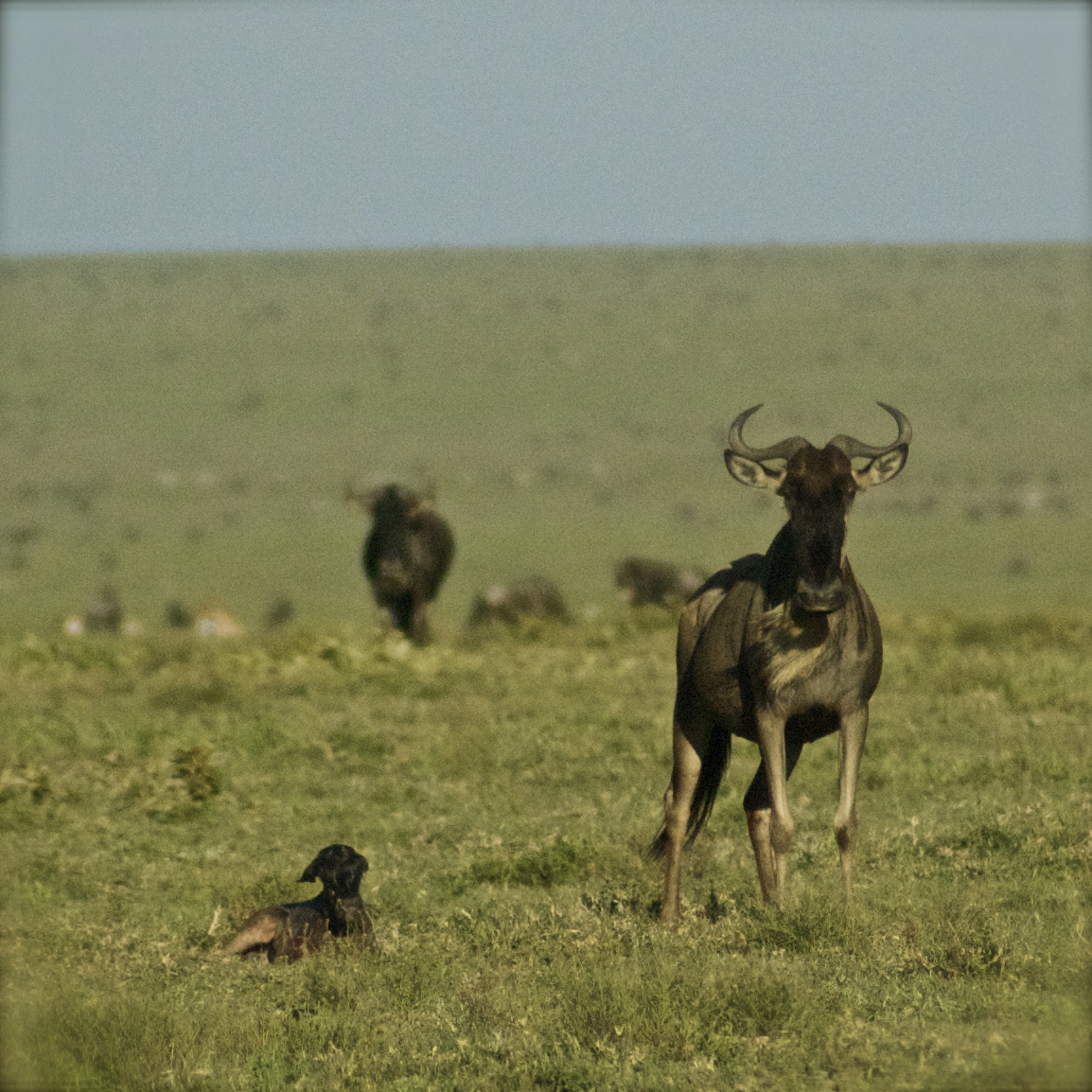
A newborn wildebeest in Piyaya. It stands within 20 minutes
 to suckle. The milk is a high-cost to the mother but she
survives because of the minerals in the grass.

So, now we understand that the whole 25,000km2 Serengeti ecosystem always has nutritious grass (and drinking water) somewhere at all times of the year. The next question we have to investigate is- why wildebeest? Why not zebra, topi, kongoni, eland etc. etc?
The simple answer:
                   Wildebeest are special.

As you might know, wildebeest belong to a tribe of antelopes called the Alcelaphines. This means they are fairly closely related and if you want to know how close, well, they are about 4 million–year-old cousins. All of them are ruminants, which means they have a four-chambered stomach that they use to digest cellulose. Rumination is a very efficient way of extracting nutrients from plants but each species will have it’s own efficiency and Coke’s hartebeest are actually the most efficient of the three species. So why isn’t it Coke’s hartebeest?
Topi in the long less nutritious grass on the Lamai wedge

We can start by looking at the mouth structure of these animals and realizing that wildebeest actually have a mouth that is perfect for eating grass that is 3cm high, which is when the grass has the highest levels of protein.

The next thing they do is chose the parts of the grass that are also more nutritious- the leaves and fresh shoots. Coke’s hartebeest and topi eat more stems and leaf sheaths than wildebeest, zebra survive on almost only stems. But there’s a lot more grass stems than grass leaves so you would rather expect zebra populations to be in the millions but they aren’t- what is actually happening, is that zebras suffer very high losses of young, so predators keep zebra numbers down.

Now, you might ask, why aren’t wildebeest populations kept low by predators?

Answer: Synchronized reproduction and rumination.

80% of wildebeest calves are born in 3 weeks in February= 250,000 wildebeest calves= 500 per hour. It is an amazing sight. In scientific terms: extreme synchronous breeding outstrips predator’s ability to limit wildebeest recruitment.

Calves are most vulnerable when they are very young but they reach a certain age when they become equally vulnerable as the other wildebeest. There is a limit to how many calves predators can take per day, so by all having their babies at the same time, more calves have the chance to live past the age where they are vulnerable. Topi and hartebeest do not have as synchronized breeding as wildebeest.
Zebra on the extra nutritious short grass plains.

As we mentioned before, wildebeest are ruminants. They spend about 8hrs a day grazing so they have 16hrs a day to look for predators. Zebra on the other hand, spend 15hrs a day grazing so they only have 9hrs to look for predators. This is because they are hind-gut fermentators. This is obviously simplified.

Now, we’ve established the benefit of synchronized breeding but there are other advantages to being a wildebeest. Serengeti’s short grass plains are the best place for the females to get the nutrients they need to lactate, but they are also a great place to spot predators, which also helps to reduce the number of calves killed before they are out of the vulnerable stage.

Finally, calves are born precocial with a very strong imprinting instinct. The mother and calf learn to recognize each other immediately by smell and the calf stands as soon as it can and then stays as close to its mother as possible. The calf then also tends to run on the hidden side of the female so that predators have a harder time seeing them. The effect= reducing predation.
Wildebeest calve's coats change color to look like their
mothers at 2 months. Predation drops drastically.

There are other minor influences and for more details download the paper, but to try to sum it up in a sentence: The Serengeti’s unique climate and soils provide the perfect conditions to allow wildebeest to live in such large migratory herds because of wildebeest’s unique biology.


Monday, 30 May 2011

10 things to talk about when there are no lions!

I've been thinking about interesting stories to share with safari visitors on those days when the wildlife just won't play for quite some time. When you're watching a lion pull down a zebra, the jackals are nipping in and out and the vultures are gathering it's easy to be a good guide. The real test is when you're somewhere and the wet season has arrived early and all the animals migrated elsewhere. How do you entertain people then?! So I've started a list of topics that I think can be interesting to chat about in those quieter times, focussing on things that are pretty much always around you in the bush, so easy to chat about in a natural way. I've said 10 things, because lists are easy - but I've already got 11 topics (10% extra free), and expect there'll be more to come. The main thing is that each of these topics is something to chat about in a quieter time. I'll be expanding on the titles in future posts, but here's the initial list to get you thinking...

(1) Grass - there's a lot of it in the savannah and surely it's got to be interesting!
(2) Fire - one of the main processes shaing the savannah, there's usually signs of it around and it's not a process many people from outside Africa think of as important or normal.
(3) Geology - not only does East Africa have a host of interesting geological features, from the Rift Valley and various volcanos, to Kopjes and plains, but the geology shapes the ecosystem by altering large-scale nutrient availability
(4) Climate and weather - I'm British, I always talk about the weather. But the East African climate is also pretty special and unusual to most visitors here.
(5) Termites - you're never far from a termite mound, and even closer to many non-mound building termites and again, they play a massive role in the savannah ecosystem.
(6) Thorns and other plant defences - everything is prickly in Africa (much more so than in many other places)
(7) Birds - a personal favourite, there are great stories to tell about birds and even if the mammals have gone the birds will still be around!
(8) Invertebrates - butterflies and dragonflies are also great for stories if you learn a few of the species.
(9) People - despite the lack of people in East Africa's National Parks, people are part of the savannah ecosystem and always have been. There's lots of evidence of it around too...
(10) Conservation - visitors often want to talk about conservation issues (and who knows, you migh just bump into an animal with a snare wound), so it's good to know the details and be able to talk in an informed way.

Of course, there are other topics too (I've one more up my sleeve already), but this is a good start. Hopefully we'll start getting posts up for each of these topics - watch this space!

Saturday, 11 June 2011

Acacia woodland

Next on the list of major savanna habitats must be the Acacia woodlands. The sun setting behing a lat-topped acacia provides one of the iconic images of an African savanna, and many of the most interesting game drives involve meandering through Acacia woodland. In fact, there are a very large number of Acacia species in Africa - something over 150 - and they're al a little different (let's ignore the current taxonomic discussions about Australia taking the Acacia genus for it's species leaving the African's with none...) . Ecologically, Acacia species play a vital role in the savanna ecosystem, but before we think too much about that, let's start by thinking about why Acacia woodlands are found where they are.
They make great backdrops, even for Flamongos! Lake Magadi, Serengeti NP Jan 2011

First, of course, we need to identify where the Acacia woodlands are and it's obvious if you're looking for it: Acacia woodlands are typically found on the lower slopes of hills and on the flatter land at the bottom of valleys. On the ridges there are generally broad-leafed woodlands, such as Terminalia and Combretrum woodlands, or in areas with a single rainy season you might find Miombo woodlands on the ridges. Boardering rivers, of course, you often find true riverine forest, another habitat again (although one that often features Acacia species). But between the riverine forest and the broad-leaved woodlands is the area where grasslands and Acacia woodlands are commonest. And the reasons for this position are probably to be found on those four main drivers of savanna ecology: fire, nutrients, water availability and grazing pressure. On the ridges, nutrients are very scarce thanks to millenia of washing by heavy tropial rains. Lower down there are more nutrients, but in consequence the grazing/browsing pressure is going to be higher - to survive in these areas you need to be very heavily defended - like the big throns on many Acacia species. The soil moisture content is also important: like other members of the Fabaceae (peas and beans being obvious examples, of course), Acacia species have a symbiotic relationship with nitrogen fixing bacteria (called Rhizobia) that live in nodules in their roots, and these bacteria are somewhat fussy about where they live. (In fact, they can life in soil away from the plants, but they are unable to fix nitrogen in isolation.)

This relationship with Rhizobia is responsible for what is probably the most important role Acacia woodlands have in the savanna: they're incredibly important nutrient pumps. Thanks to their nitrogen fixing bacteria, Acacia species have a pretty much unlimited supply of organic nitrogen, vital to producing proteins and growth. In the generally rather nutrient poor soils of Africa, this has a massive impact. All the browsers love a snack on the nutrient rich Acacia leaves, despite their thorns and high tannin content. But most importantly, at the end of the wet season Acacia trees drop their leaves like most other savanna plants - but because they have such a plentiful supply of nitrogen, they don't bother withdrawing all the nutrient before they do so. This is immediately obvious if you drive the savanna at this time of year: Acacia trees remain greenish right until the leaves fall, other broad-leaf species withdraw as much nutrient as possible, resulting in yellow or orange leaves, before they fall. And the consequence of this is that Acacia leaf litter is much richer than the little of other species and fertilises the soil under the trees. So effective is it, that in some places Acacia litter is used as a major fertiliser for poor soils.

Again, the impact of the richer soil is immediately obvious if you go and look under an Acacia - there's a whole lot more diversity in the herb layer than under a neighbouring non-Acacia species.
Lots of herb diversity in the understory of an Acacia woodland thanks to the fertilisation effects. Near Mbalageti River, Serengeti, Jan 2011.
Not much under a Balanites but grass (oh, and a few animals) - Grumeti GR, Sep 2010
This diversity, combined with the fertilisation effect making everything rather more nutritious than elsewhere in the savanna explains the reason you spend so much of your time on game drives in Acacia woodlands: everything loves them! Of course, the problem with this is that it attracts lions and other predators who hunt much more efficiently from the cover of woodlands, so if you're a browsing animal you've got to choose: do you got for the nutrient rich woodlands and under-story of the Acacia belt but face the higher risk of being eaten yourself, or do you avoid the richer habitats and forage in safer places where you can keep an eye on predators much more easily? If you're sensible, of course, you'll probably balance the two options up and make decisions based on exactly how much you need those nutrients at any one time – early in the dry season there's plenty of forage in the open grasslands and you've had plenty of nutrients recently during the wet season anyway, so you might spend more time in the grasslands. Later in the dry season those open areas may have been grazed to nothing and you're more in need of nutrients as you might well be preparing for pregnancy, so you might decide to take the risk and forage in the woodlands: at different seasons, different strategies make most sense and within the savanna ecosystem such movements are very sensible. Of course, you might also decide to just live on the woodland margin – nipping into the woods when you're fairly sure there are no predators around, but in easy reach of the open areas if you're more worried. This, of course, means that those ecotones – the transition from one habitat (Acacia woodland) to another (open grasslands) – are going to be fantastic places to explore on your game drive.


And that, for now, is probably enough about Acacia woodlands. There's lots more to say about both Acacias and the woodlands, but as an introduction to the habitat it's not a bad place to start.
Acacias do make for nice sunsets! Here some herons roost on a bit A. tortilis near Lake Ndutu, Serengeti, Jan 2010

Sunday, 10 July 2011

Riverine forest- forest in the savanna biome

Majo Moto near Boma Ng'ombe - thick riverine forest is protected from browsers and fire

I spent the weekend with my family and friends camping at Maji Moto near Boma Ng'ombe. As the name suggests, this is a hot (well, warm at least) spring in the middle of some pretty dry Acacia – Commiphora scrub. There's a pretty impressive flow of somewhat warm water out of a cave forming a nice river that, as you might imagine, if a complete contrast to the surrounding dry, and it inspired me to think about riverine forest again. Already this year, it's pretty dry in lots of places (though I hear there's rain in western Serengeti), and everywhere is pretty dusty and dry. Except, that is, the riverine forests. Here the trees are still green, there's plenty of shade and the contrast is amazing, but this is just a hint of how different riverine forests will be from the surrounding vegetation in another couple of months as the dry season starts to bite.

Acacia commiphora scrub in the foreground with tall, green riverine forest in the back. Maji Moto, July 2011
So, where are riverine forests special and what role do they play in the savanna ecosystem? The first special thing that's immediately obvious is that they're green, when no-where else is. Ti understand what makes riverine forest special we're going to think again about nutrients, fire, water and grazing.browsing, the big four of the savanna ecology world. Lots of riverine trees are evergreen, or nearly so. And the reason they can keep green is that they typically have incredibly deep roots, penetrating right down into the water-table. With a few exceptions, the surrounding Acacia and Commiphoras tend to have shallow roots, spreading horizontally just below the surface of the soil, spread out and designed to catch as much of the water that falls on the surface as possible, very different from the tap roots of the evergreen riverine forests. Tap roots only work if the water table below ground isn't too deep, and alongside rivers that's fairly likely, so water-availability is the main factor altering the ecology of riverine forest.

Look closer and you'll notice some other things – trees of the riverine forest are often not thorny, in complete contrast to the surrounding vegetation. Now why is this? Obviously thorns are to do with defence against herbivory, so something about these trees means they somehow escape herbivory in a way that the surrounding habitats can't. That's odd, given that rivers are generally excellent places to find animals. So the key here isn't that the herbivory is much lower than in the surrounding woodlands, but that the tree growth rates are much higher and the trees themselves are larger, all thatks to that ready availability of water. So once established, riverine trees can grow all year around, escaping from even the tallest giraffe in a fraction of the time water-limited plants in other habitats need. So although the animal densities can be high, the impact of herbivory is less, at least on mature trees. Now that is a problem for seedlings, of course – although they grow fast, they still need to escape heavy herbivory whilst they're short, and this the achieve by heavy reliance on nurse plants – plants of other species (bushes and shrubs) that are well defended against herbivores, but that allow the seedlings of the riverine species to sneak in among them and also escape herbivory. Once the forest is dense, of course, the mature riverine forest can be so dense (especially if there's a dense palm understory that nothing can get into) that herbivores are basically precluded anyway, making regeneration of the forest fairly straight forward. So herbivory also plays a part in the riverine system.

And finally, fire is a big issue in riverine areas. Typically, trees of the riverine forest (like other forest – and riverine really can be a forest habitat attracting many species typical of more montane habitats, particularly in our current cold season) are fairly sensitive to fire. That's not much of a problem for them in general though, as they're usually green and moist, dense and with little grass in the understory (especially if there are lots of buffalo around keeping it short around their preferred river habitats), so don't have lots of dry fuels waiting to burn. In fact, riverine forests can play an important role in fire suppression, allowing different fire regimes on one side of a forest strip to the other. This sensitivity, however, causes a problem if you burn an area too much so the nurse plants are burnt off (one of the reason we think many of Serengeti's riverine forests are currently on the way out). And once recruitment is lost in this system, it's really difficult to re-establish riverine habitats, as the natural fire suppression is lost, and the herbivores are also given much better access. A savanna with healthy riverine forest is therefore likely to be well managed savanna.
Otolemur garnettii, common in Riverine Forest. Maji Moto July 2011

Figs are a valuable year-round food resource in riverine forest

Fallen ones are eaten by everything!
 And riverine forest is, of course, a vital habitat for many species. I've already mentioned the fact that buffalo like to hang out in these areas, and they have their own set of animals too. They're great places in the shady spots to find leopards, or you might look for some of the more specialised riverine species too – lots of good birds, loads of bush-babies and maybe tree hyrax, etc. Obviously many game drives take in riverine forest, particularly in the dry-season when they're the only green areas around, especially as they're one of the only habitats at this time that has fruit on offer – figs are everywhere in the riverine forest, and there's always some ripe somewhere nearby. Figs are on all rivers, but up here Tamarind is a pretty specialised riverine tree too, and you'll often find Marulas on the rivers too, all excellent food sources for monkeys, baboons and birds, plus the fallen fruit are loved by bushbuck, elephants and just about anything really! At this time of year when food is hard to find in the open savanna, riverine forest really comes into it's own and lots of animals will make extra use of the habitat during the dry season. All in all, a very important part of the savanna ecosystem, both through proving food resources, but also from it's role as a fire break, etc. And you can have lots of fun in the river too!

Many special birds are easiest to find in riverine forest – a Pygmy Kingfisher, July 2011
In the cold season
higher elevation forest species like these Black Saw-wings follow rivers into the lowlands

Monday, 2 April 2012

100th post!

Safari Ecology comes of age with this, it's 100th post! It seemed like a useful moment to review progress so far.

We set out to be a resource primarily for guides in East Africa, posting things about the ecology of the area and recent scientific studies that might make for useful or interesting information. With that primary purpose in mind it makes sense to announce that Ethan has organised a whole set of new guide training activities for April and May - as well as the obvious comprehensive 6ish week training course on natural history, ecology and the like, there are courses on first aid, psychology for guides and others too! The course should be suitable for anyone with a bit of guiding experience and should get you to a level that, once the syllabus is finalised, will be ready for testing under the new Tanzanian guiding standard that's being developed. Check the dates and things here and if you want to know more contact Ethan directly.
Daily visitors from the three top continents: Blue = Americans, Red = Europe, Green  = Africa