 |
| Pangani Longclaw Macronyx aurantiigula is perhaps the best example of a species extending west, having colonised Serengeti recently. |
Tuesday, 9 July 2013
What is the influence of climate change on Tanzanian protected areas?

Wednesday, 1 May 2013
Indian house crows and invasive aliens
 |
| Indian House Crow, not the prettiest... Thanks to Dick Daniels |
First though, identification is fairly simple: the house crow is a medium-large all black and grey bird, usually found in flocks in towns all along the coast and, in some areas, invading inland too. It is very loud, with a persistent "Carr, Carr, Carr" call that is the constant sound of Dar es Salaam bird life... There are few confusion species in East Africa, the only other common species of crow being the black and white Pied Crow, which often hangs about with the house crow.
Wednesday, 10 April 2013
Common birds: Rattling cisticola and why birds hold territories?
 |
| Rattling Cisticola, near Arusha, March 2011. Something of a birder's bird? |
First the identification. Let's be honest, Cisticolas can be something of a challenge to identify! It doesn't help that there are seven pages of nearly identical looking small, streaky brown birds in the fieldguide! Happily, there are better ways to identify Cisticolas than their looks - the key is always to listen. Most Cisticolas, and rattling is no exception, have fairly distinctive calls and once you know it their 'tee, tee, churrurrurr' call is a constant sound in the bush (click the link to find a recording on xeno-canto), especially during the rains when they breed. In the unlucky event that none are making any noises, you can usually be fairly confident in your identification of any moderately sized, streaky cisticola present in the drier bush regions as rattling simply because they're so common! They are surprisingly variable in size (sometimes appearing really rather small) and colour (from very grey to warmer brown - but never with bright chestnut on the wing or head) though, so don't be too taken in my any one feature if they're not calling.
Wednesday, 3 April 2013
How to protect lions?
 |
| Lions: just big kitties really! |
Thursday, 14 March 2013
Common birds: Red-billed Quelea, commonest bird in the world?
 |
| 1000s of quelea at a dam on Manyara Ranch |
So, first the identification. The most obvious thing about red-billed queleas are, as the name suggests, a large red beak! Apart from that feature, females and non-breeding males are rather nondescript, small sparrow-like birds. Breeding males are rather brighter, with the red bill surrounded by a black face and variable amounts of orange on the top of the head and breast, with otherwise sparrow-like brown streaks on the back and wings. Perhaps the most useful identification feature though is the fact that you almost never see just one, but flocks of tens, hundreds or thousands of busy quelea all searching for grass seeds or drinking at waterholes.
Thursday, 31 January 2013
Common Birds: the case of the Baglafecht Weaver and missing forests
 |
| Male Baglafecht Weaver, Mt Kilimanjaro |
If you live on or near an East African mountain, you're very likely to have Baglafecht Weavers in your garden. Like most of the other true weavers, they're a basic black and yellow colour. The first thing to look at in weavers is usually the colour of the eyes and legs: in Baglafecht weavers you'll always see a yellow eye (easy to see against the surrounding black feathers) and pink legs. Males and females differ slightly: males in the population in northern Tanzania and Kenya have only a black mask on the face, with yellow on the top of the head right down to the (black) beak. Females have an all dark head. In northern Tanzania the back of both sexes is essentially black, with some yellow wing edges, in other areas of Tanzania the back is greenish/grey and not as strongly contrasting. Juveniles of all forms are rather greener and lacking in black, but still have the yellow eye. Like other weavers, they weave their nests from grasses in colonies of 5-15 pairs (not usually in very large groups) and males in the breeding season are pretty noisy with their rather scratchy and squeeky song!
 |
| Baglafecht weaver nests aren't the neatest of affairs... |
Wednesday, 23 January 2013
Common birds: Ring-necked Dove
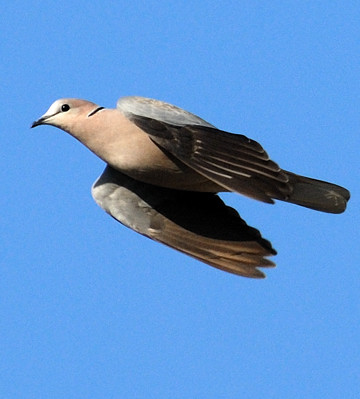 |
| Ring-necked Dove (Cape Turtle Dove) in Tarangire, photo from here |
The sound of the Ring-necked Dove is one of the constant backgrounds to a safari in the bush (if you don't know it, the "work harder, drink lager" refrain is available here) and it's actually this distinctive song that is the easiest way to identify the species from among a number of confusingly similar species. The ring-necked dove is a medium sized, grey dove. It has a black collar around the back of its neck and is a paler grey white below, with pale edges to its tail. Unfortunately, that description is would cover just about any of the close relatives of this species, and (as well as listening to the calls) you need to look rather closer to identify the species correctly. Firstly, look at the eye: if it is dark and not obviously surrounded by bare skin, you're probably looking at a Ring-necked Dove. White (not grey) edges to the tail and a generally pale grey would confirm the identity in eastern and southern Africa. If the eye is pale yellowish, with a red ring around it and there's a warmer brownish wash to the back and neck that contrasts with a grey head, you're probably looking at an African Mourning Dove (call) and if its got a dark eye in a bare purple/red patch of skin, and is overall darker looking, with grey tail edges, you're looking at a Red-eyed Dove (call: "I am a Red-eyed Dove").
Sunday, 6 January 2013
Common Bulbul and frugivorous birds
 |
| Common Bulbul nesting in Arusha |
Friday, 7 December 2012
Common birds (1)
 |
| Speckled Mousebird, Arusha. Cute, and really quite interesting... |
So, let's start today, in no particular order, with the Speckled Mousebird.
Thursday, 1 November 2012
Ground Pangolins and Convergent Evolution
-->

On a recent safari I was fortunate to get my first ever
sighting of a Ground Pangolin. This animal is quite fascinating.
1.
What is it?
Kakakuona
(Swahili) is a mammal that belongs to its own Order called Pholidota. It is a monophyletic order which means there is only one
family Manidae.


2.
What is it doing?
Sunday, 2 September 2012
Cycads and more botanical revolutions I've missed...
 |
| Lake Natron Cycad, near Loliondo. Cycads look rather palm-like, but are not true flowing plants at all. |
Now I have a confession to make - once again I was completely wrong!
Tuesday, 7 August 2012
Do fires stop the Serengeti migration?
 |
| Dr Kate Parr lighting a controlled fire in the Serengeti Ecosystem |
Thursday, 14 June 2012
East African Butterfly families and corrupt, singing caterpillars
 |
| Citrus Swallowtail, Papilio demodocus, is very common in Tanzania |
Monday, 4 June 2012
More on management of protected areas: the human dimensions.
 |
| Public relations are a huge part of conservation work |
Saturday, 2 June 2012
On managing protected areas...
 |
| Spot the scientists! Prizes for anyone who can name at least 4... |
Thursday, 31 May 2012
Why do scorpions fluoresce and other such trivia...
 |
| Scorpions - everyone's favourite! |
Friday, 18 May 2012
The big burn...
So, I promised more details would come, so here goes with some more background and some of the detailed plans I've got to burn Serengeti. If you like what you see don't forget to support the project over here!
So, hope that fills you in with lots of details! If you've got this far you're obviously really, really interested so please do go to the project page and support us! Every little bit helps...
There
are few active management activities taking place in most of East
Africa's protected areas – a policy that has so far proved fairly
effective at managing functioning ecosystems. However, one of the
management activities that does happen in many areas, is burning.
Fire is generally considered a vital component of savannah ecology,
with trees, grasses and animals all adapted to a fire prone
ecosystem: in fact, globally, 85% of fires occur in savannah
habitats. In most of Tanzania's protected areas, rangers deliberately
set fires each year for a number of different purposes, including the
encouragement of new grass growth for grazers and the control of bush
spread. Recent evidence from a global study suggests that at least
for those savannahs occurring in areas with over 1000 mm of rainfall,
the forest/savannah edge is often maintained primarily by fire, and
that in its absence many savannahs will revert to forest. There is
some debate, however, about whether grazing and browsing alone may
provide an equivalent process when animals are at particularly high
densities, with the result that the benefits of fire in certain areas
have been questioned. For example, in some areas of Tarangire
National Park with high numbers of migrant animals during the dry
season, fire has been totally suppressed for over 30 years with
relatively little obvious difference in grass and tree cover between
fire-suppressed and more frequently burnt areas: it is argued that in
the burnt areas fire simply burns potential animal forage. Similarly,
in Kenya, the Kenya Wildlife Service has recently instigated an
overall policy of fire suppression except where the fire is caused by
natural events (essentially, lightening storms) in an attempt to
encourage one view of naturalness. There are, of course, alternatives
to these two extremes, where fire is sometimes suppressed and
sometimes encouraged. Given that fire is one of very few activities
conducted by management in these areas it seems sensible to
understand more fully the consequences of these different management
decisions.
Traditionally,
pastoralist communities in northern Tanzania have set fires towards
the end of the dry season, in anticipation of the rains. They make a
calculated gamble between burning possibly useful forage if the rains
are delayed, and waiting too long and being unable to burn (and
encourage the new growth that will come with the rains) if the rain
comes before they have time to burn. Obviously, by this time of the
year grazing animals will already have reduced fuel loads to
relatively low levels in many areas, so late dry season fires will
only occur in less grazed areas, with other areas remaining unburnt.
Such management was also the norm in many protected areas (including
Serengeti) until around 1970, when concern over the regeneration of
trees prompted a switch in fire management towards controlled burns
in the early dry season (mainly in June). Such fires are generally
cooler and patchier, with possibly less impact on woody plants. They
also prevent the late season burns that are likely to be hotter and
less easy to control with consequent reduced concerns about tourism
infrastructure. Recently, managers of the Grumeti Reserves in western
Serengeti have attempted to suppress early season fires, only
allowing burns later in the dry season (from late July), allowing the
migrant wildebeest and zebra to graze unburnt areas and increasing
the forage available to these animals to the extent that their
residence times within the reserves have tripled. Fires are also set
during the short dry season, in February, and grass growth rates are
such that some areas of the national park burn twice per year.
Observations suggest that areas burnt in February may be preferred by
migrant ungulates during June, but beyond these patterns and the
immediate, short-term responses of grazing animals, we understand
relatively little about how fire impacts the ecology of Serengeti or
other East African protected areas in the bimodal rainfall area.
Whilst we know a little about the impacts on large mammals and early
vegetation responses, we know almost nothing about the impacts on
other taxa, or the soil fauna and nutrient flows of the savannah
ecosystem.
In
practice, over much of Serengeti, fires occur once or twice per year.
If there are species within the ecosystem that are rather more
sensitive to fire than others – for example, ground nesting birds,
toutoises or various plant species – such frequent fires may have negative
impacts on the population. On the other hand, burning in different
seasons may affect different species in different ways. Whilst it is
generally considered 'a good thing' to burn Serengeti whenever it can
burn, maybe reducing this frequency doesn't actually have the
negative impacts expected and could, instead, benefit other taxa not
usually considered in protected area management plans? How many
unburnt seasons does it take before grass quality starts to decline?
Would a general switch back to late-season burning be beneficial? The
only way to answer these various questions is a detailed, but
large-scale study of fire impacts in the Serengeti ecosystem. To
date, there have been a few relatively small scale and short-term
fire experiments in the ecosystem, there have also been longer-term
but equally small scale studies in other African savannah systems.
Both have provided insights into the management of fire in these
systems, but only in Australia (where herbivory plays a completely
different role) have experiments been carried out on a large scale in
savannah ecosystems, providing a different range of insights to those
of small scale experiments. Large-scale and long-term management
trials in an area of bimodal rainfall will provide insights of
relevance not only for the Serengeti ecosystem, but also for savannah
ecology in general.
So, what am I actually planning to do? It's all fairly applied. My aims are (I hope) clear:
- To understand the impacts of alternative fire management options on the ecology (both pattern and process) of the Serengeti ecosystem
- To be able to inform managers on the best way to use fire as a management tool to achieve their stated aims.
- To understand the importance of fire and grazing in shaping the ecology of the Serengeti ecosystem across the rainfall gradient.
Frequency
treatments:
'Maximal
burn': corresponding to a burn-if-you-can treatment as carried out
across much of the National Park, with fires set whenever possible.
'Hold-back':
corresponding to a management regime that notes when burning would be
possible but delays by one or two seasons until fuel loads are
higher.
'Minimum
burn': corresponding to a management regime that attempts to suppress
fire return rates to 4-5 years, a frequency that has been suggested
to be suitable for recovery of riverine forest and thickets.
Seasonal
treatments:
'Early
burn': corresponding to the long dry season management regime across
most of the National Park, where fires in the long dry season will be
permitted at the end of the rainy season – in northern and western
areas of Serengeti (e.g. the western corridor) this will be before
the migration arrives.
'Late
burn': corresponding to the type of management traditionally carried
out by pastoralist communities, with fire suppression during the
first part of the long dry season and burning set in anticipation of
the rains.
'February
burn': corresponding to areas where management will attempt to burn
in the short dry season and suppress fires in the long dry season
(only northern and western Serengeti).
And where will we be doing this? Well, the study sites are burn management
units within the TGT concessions of Maswa Game Reserve, within the
Mwiba Holdings private concession around Makau Village and on Grumeti
and Ikorongo Game Reserves and the adjoining Wildlife Management
Area. These areas include a near complete range of
Serengeti ecosystem habitats and rainfall gradients, from dry
Acacia – Commiphora woodland and short grass plains in Mwiba
Ranch, to Terminalia - Combretum woodlands and tall
Themida grasslands in the Ikorongo and Grumeti Game Reserves.
In total, the area managed within these three reserves is in excess
of 2700km2 (270,000ha), making this study easily one of
the largest experiments in the world. Burning blocks within each
reserve will be assigned to fire treatment, stratifying for size and
rainfall across the entire set of study areas.
In addition to the experimental work in
the reserves surrounding the Serengeti National Park, we will conduct
similar monitoring activities at sites within the National Park, to
ensure that the 'maximum burn' treatments within the experimental
areas show ecological dynamics similar to those within the National
Park.
So, hope that fills you in with lots of details! If you've got this far you're obviously really, really interested so please do go to the project page and support us! Every little bit helps...
Tuesday, 15 May 2012
Breaking the silence...
Hello everyone, and apologies for being offline for so long! I've been running around like a mad thing - Manyara, Loliondo, Ndutu, Cape Town, you name it, I've been there! I'm now back home and full of ideas for lots of new posts to keep things rolling. Whilst I sort out my photos and 1000s of emails I thought I'd bring to people's attention one thing I'm up to next. Regular readers will know I have a thing about fire in savannas and may even have picked up my plans to do a large-scale burning experiment around the Serengeti NP (I mentioned it here...). Well, the project has been officially approved and will be happening, but we're trying to raise some money to help get started and we're trying out crowdfunding as an experiment. What's crowdfunding you ask? Go and find out here! Using the newly set up website called Petridish, we're trying to get some start up funds in the next few weeks - there's opportunities for anyone to donate online, any amount, and some fun rewards to donors too! There are loads of other projects all looking for funding on the Petridish site, so we need to get some momentum going and then the site will push us harder too. I'll post some of the rationale for the experiment and more details here soon, but please do spread work about this and make a donation, however small, as soon as possible! There's a deadline on donations, and if we don't get the money we've asked for by then all the money goes back to the donors... Launching today, we've still got a long way to go! So, share the word, donate and (if you can bear it) watch me explain the project on the little video!
Here's the link to read about the project, see the pictures and video and make a donation. Thanks!
Tuesday, 3 April 2012
African Vulture Declines
 |
| I saw this hooded vulture in Tarangire this weekend, so they are still around! |
Monday, 2 April 2012
100th post!
Safari Ecology comes of age with this, it's 100th post! It seemed like a useful moment to review progress so far.
We set out to be a resource primarily for guides in East Africa, posting things about the ecology of the area and recent scientific studies that might make for useful or interesting information. With that primary purpose in mind it makes sense to announce that Ethan has organised a whole set of new guide training activities for April and May - as well as the obvious comprehensive 6ish week training course on natural history, ecology and the like, there are courses on first aid, psychology for guides and others too! The course should be suitable for anyone with a bit of guiding experience and should get you to a level that, once the syllabus is finalised, will be ready for testing under the new Tanzanian guiding standard that's being developed. Check the dates and things here and if you want to know more contact Ethan directly.
We set out to be a resource primarily for guides in East Africa, posting things about the ecology of the area and recent scientific studies that might make for useful or interesting information. With that primary purpose in mind it makes sense to announce that Ethan has organised a whole set of new guide training activities for April and May - as well as the obvious comprehensive 6ish week training course on natural history, ecology and the like, there are courses on first aid, psychology for guides and others too! The course should be suitable for anyone with a bit of guiding experience and should get you to a level that, once the syllabus is finalised, will be ready for testing under the new Tanzanian guiding standard that's being developed. Check the dates and things here and if you want to know more contact Ethan directly.
 |
| Daily visitors from the three top continents: Blue = Americans, Red = Europe, Green = Africa |
Subscribe to:
Posts (Atom)