Showing posts with label Forests. Show all posts

Thursday, 12 January 2012

What is the savanna biome?

Savannas around the world are often open woodland like this Serengeti pic.
Remember a few months ago I reported on some talks I'd enjoyed at the ATBC/SCA-Africa meeting here in Arusha? Well, the research behind one the the talks I enjoyed most was published late last year and I think it really helps explain what makes the savannah biome (which is probably why it was published in Science - great job Carla!).  However, before going into too much detail about this research, I think it's important to make sure we know exactly what I mean by a biome in the first place...

When I talk of the savanna biome (or, indeed, the savannah biome, since I am English) I'm not referring to a habitat like grassland, or Acacia woodland; nor am I referring to a specific ecosystem like the Serengeti Ecosystem. Rather, I'm refering to the set of habitats that make up the savannah biome globally - the collection of grassland and woodland types that all have the same main processes operating on and in them, the savannah big four are, of course, nutrients, water availablity, herivory and fire. They might (and often do) contain remarkably different species, but the same processes are at work and, to remarkable degree, they show largely similar vegetation forms and structures. A biome may therefore be thought of as a set of habitats that share similar ecological processes wherever they occur across the world. By contrast, I tend to define an ecosystem as a single geographical area (like the Serengeti Ecosystem), within which nutrients are cycled with relatively little input or output from neighbouring ecosystems. Hope that's clear...
Fire is crucial to maintain savanna, particularly in wetter areas. Tarangire July 11

So, if we're going to understand what the savanna biome is, we need to look at the processes that are the dominant forces within it. If we can understand these, then we can predict where savannahs will be found throughout the world - and we can also understand what might happen to savannahs if we humans mess around with these processes through, for example, the effects of climate change. And this is exactly what Carla Staver and her co-authors have done in their paper (which I'm afraid is probably hiding behing the paywall here). They were particularly interested in discovering what determines the boundary between forest and favanna biomes (the boundary with desert is a much more obviously rainfall driven boundary), and decided that the most likely factors were rainfall and fire. Whilst that might well be true, there's plenty of evidence that herbivory is a major player too (at least here in Africa) and nutrients have been proposed as major players too (though there's also plenty of evidence to suggest this really isn't the main thing). However, they didn't look at these - herbivory they mention but exclude from their analysis with the very reasonable excuse that we just don't have a good idea how much herbivory there is around the world, but I think it's a bit of a shame they didn't have a go at nutrients too. Still, enough of what wasn't looked at - what did they find?

Monday, 1 August 2011

Coastal Habitats

Common Sandpiper on mangrove creek
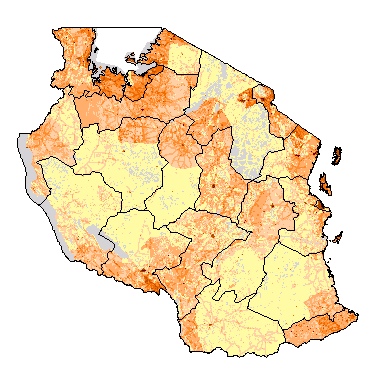
So, in what's probably going to be the last coastal blog until I get back to the beach again, I thought I'd give a first introduction to some of the interesting coastal habitats. (Note the logical progression - off stuff in the sea, interesting things on the shore, and now interesting things on the land but near the sea. Anyone would think I had it planned!) So, let's start by thinking about what's down by most beaches. And in East Africa you don't have to spend long before realising it's basically a mixture of coconut plantations and sisal estates, with a bit of cashew thrown in for good measure. So you won't be surprised to learn that the northern coastal regions have some of the highest population densities in Tanzania (here), though to be fair most of the plantations were originally started by colonial Germans and Brits some time ago. So the remaining native habitat fragments are in a rather bad way, and can be hard to find. They are worth seeking out, though, as ther are some special things living in them.

For the purpose of this post, I think I'm going to focus on the two of the most interesting coastal habitats: coastal forest and mangroves. Coastal forest has obvious functional similarities to forests elsewhere in Africa, though the species composition can be pretty different. Mangroves, on the other hand, have no inland analogues, so let's start there.
Mangroves still do grow on open coasts here north of Pangani

If you've not seen them, mangroves are starkly different to any other habitat. They're mainly tropical in distribution (there are some in the Australian temperate zone, and a few on the East Coast of the US, but these are the exception that prove the rule), and once upon a time would have occured on any tidal zone (ie, on land covered by the high tide, but exposed at low tide) with a minimal degree of shelter from the full force of the sea - they used to cover over 3/4 of tropical tidal areas. At one time, that included even rather isolated islands like Maziwe, but now you'll rarely find them on the beach front themselves, but mostly limited to tidal creeks. And you'll know when you find one, because you'll be walking through the coconut plantation and suddenly hit a dense, dark and glossy thicket growing like a wall out of the bar mud or sand (sometimes even rock) substrate.
Mangrove edge in cocnut plantation, Ushongo Beach July 2011

If you can make your way through the mangroves, you'll see some interesting sights. Down on the ground the most obvious things are the arial roots - sometimes poking up like fingers, other species rely on multiple branches from the stem. These have a wonderful scientific name - pneumatophores - and their purpose is simply to allow the plants absorb air. But they also form a unique and busy microhabitat of their own - a mini-forest that traps passing mud and can harbour much richer muds than surrounding areas as well as providing lots of nice little places to hide from predators. Consequently, the root systems of mangroves are home to lots of life - there's always crabs to see, and in areas nearer to low tide limit there are often air breathing fish called mudskippers, which are kind of neat and perhaps remind us of our distant ancestry... What's more, these root systems are often extremely important nurseries for the young of reef fish important in many local fisheries.
Aren't those roots odd! Mangrove pneumatophores, Ushongo Beach

These pneumatophores aren't the only interesting adaptations of mangroves though - not only do the have to survive in water-logged soil, but it's very salty too (and in areas where shallow seawater sits around in the hot sun the concentrations of salt can be extremely high) and most plants can't tolerate salt. Mangroves have a number of adaptations to help, of which the most obvious is the glossy, thick leaf itself which reduces water-loss. But more fundamental are adaptations to the root that we can't see that simply filter the salt out of the water - by the time water arrives in the root, 82 - 97% of the salt has been filtered out. Given how difficult we find it to extract frest from salt water mechanically in desalinisation plants, that is a remarkable adaptation! And then what salt does get into the plant can be collected and excreted through the leaves, giving them a silvery appearance at times.
These roots also  absorb air in another mangrove species, Ushongo Beach

In such harsh environments, it's going to be particularly tricky for seedlings to thrive, so mangrove species have another neat adaptation up their leaves - they're (mostly) viviparous. What? Live-bearing plants?! Yes indeed, most mangrove species don't immediately drop their fruits, but retain them on the plant whilst the seedlings develop to a stage where they can photsynthetise themselves - some seedlings growing entirely inside thr fruit, others growing through and out. Then, when they're ready, the plant drops them either like a dart into the mud below them, or into water to float the seas until washed up in some suitable substrate, when the young plant is ready to go. Which explains why many mangrove species have extremely large distributions, dispersing on cross-oceanic currents.
Mangrove fruits germinating on the plant and ready to fall.


So, that's the structure of the mangrove, and it's obvious that this sort of harsh environment is going to be home to species of plants that are survivors - all their obvious competitors are eliminated by the environment itself. And just as the roots are home to lots of little beasties, the trees themselves are home to a pretty good selection fo birds and animals too. The really special bird to look out for in this area is Mangrove Kingfisher, but the mangroves can often be full of mixed species flocks of starlings (mainly Black-breasted), barbets and greenbuls, etc. Some great birding to be had if you can see into the thickets!


So, all in all, mangroves are wierd but great coastal habitats. And it's a shame there aren't more of them, because they are fantastically useful to us too, not least through their very impressive abilities to mitigate against the impacts of tsunamis.


Hmmm. Well, seems like this is probably a long enough post for now anyway, so coastal forests can wait for another time. Ecologically, they're rather similar to other forest types anyway, even if the species they hold are sometimes very different!

Tuesday, 19 July 2011

Connecting forests and savannahs

Pre-montane forest - note the high diversity of tree species, Lake Duluti, July 2011
In my last post I said I's intended to talk about the connections between forests and savannahs, but got distracted by pretty birds. So I thought I'd do it now instead, becuase it's still an interesting topic. Once upon a time, a surprisingly recently time ago, there were rather more forests in East Africa than there are today: even in the relatively well-wooded Eastern Arc mountains, it seems like nearly 80% of the prehistoric forests have been lost. And they were an important part of the landscape - both in their own right (harbouring massive biodiversity with hundreds of plant, vertebrate and invertebrate groups endemic to the Eastern Arc), but also through the role they play for many savannah animals.
Montane forest in Arusha NP is kept open by grazing and browsing - that's a C3 grss understory. June 2011

We've already seen that forest and savannah can both occupy areas where the rainfall is over 1000mm per year, and that fire seems to be the key factor determining which actually wins out. We've seen how riverine forest is a forest habitat within the savannah biome, and we probably also know that thickets are fairly similar too. But true forests are different, and we don't usually think of them as connected to the savannah at all. Yes, forests are different - they're not dominated by C4 grasses (though they can still have some pretty thick understory of C3 grass) as we've seen defines the savannah biome, but I think this distinction is unfortunate as they are connected, at times vitally so.
Forest C3 grass species - short, round leaves are typical. Duluti July 2011

Yes, it really is a grass!

For example, the loss of forest in the Mau escarpment that feeds the Mara river is believed to be responsible for the altered hydrology of the Mara river within the Serengeti-Mara ecosystem - less forest means less water is soaked up by the landscape, so more flows down the river in the wet season and less remains to flow during the dry season. More directly, East African forests provide homes for many of the species more typically associated with savannahs. You might not visit Arusha NP to see the elephants or buffalo, but they're there. And what's more, those elephants move - they go down the Ngara Nanyuki river and down onto the savannahs of West Kilimanjaro. Where, of course, they must meet elephants that have done the same from the forests of Kilimanjaro and those that have come out of Amboseli. The same seasonal movements of elephants into and out of forests is a regular pattern, whereever such movements remain possible. Typically, savannah elephants will move into the moister forest habitats during the dry season when food becomes scarcer and poorer quality on the savannahs. But elephants aren't the only animals making this movement - in other areas where the savannahs are moister than around West Kili, buffalo and several other species make the movements too, though it's usually a shorter-distance movement and less seasonal.
Buffalo (and other forest mammals...) Arusha NP, December 2009

We all know of the regular movements and migrations of many ungulates. This is usually driven in part by the need for dry-season forage (we'll have to post more about migrations later). But what's interesting even about the well-known Serengeti migration, if that's its variable both in route taken, and timing. And the key driver is food and water availability - if there's food and water around, the animals stay longer, if they see/smell rain somewhere else, they shift their routes to exploit it. This is a very sensible response to living in a highly variable environemnt, and it seems that many savannah animals are similarly flexible when they need to be, even if they don't show large-scale and well-known migrations. So the forest and thickets of the northern Mara can be heaving with wildlife during droughts, and provide an important buffer for animal populations when conditions get really harsh. Indeed, the loss of forest in Amboseli is believed to be one of the key changes that meant the drought there in 2009/10 had such a serious impact. It seems that many animals have their regular dry-season refugia (often wetlands like Silale in Tarangire) but if these dry up in a really bad drought, they'll move to the nearest forest and tough it out there. But if the forest patches have disappeared - particularly the lower-elevation forests - or are now separated by fences, then the animals can't do this ocassional movement and there's going to be trouble. So although true forests aren't usually considered part of the savannah biome, they certainly have a role to play in a well-functioning ecosystem. And what's more, they're a great change from the savannahs for visitors to East Africa, so don't avoid them just because you won't find lions there!