 |
| Lions: just big kitties really! |
Showing posts with label Zoology. Show all posts
Showing posts with label Zoology. Show all posts
Wednesday, 3 April 2013
How to protect lions?

Thursday, 1 November 2012
Ground Pangolins and Convergent Evolution
-->

On a recent safari I was fortunate to get my first ever
sighting of a Ground Pangolin. This animal is quite fascinating.
1.
What is it?
Kakakuona
(Swahili) is a mammal that belongs to its own Order called Pholidota. It is a monophyletic order which means there is only one
family Manidae.


2.
What is it doing?
Friday, 30 March 2012
Revising climate impacts on African vertebrates

Wednesday, 21 March 2012
Why is snake venom so toxic?
 |
| Puff-adders probably cause more human snake-bites than any
other
African snake, but are rarely fatal. This is a juvenile, but don't think it's harmless. |
Tuesday, 28 February 2012
Exercise like a lion!
 |
| Wildebeest wrestling - the ultimate fitness regime? Selous GR, June 2010. |
Tuesday, 14 February 2012
Tarangire wildebeest migration
 |
| Tarangire wildebeest on the move, Sep 2011. |
Thursday, 9 February 2012
Why is the African Savanna so full of thorns?
 |
| Giraffe lick leaves between thorns. Note how obvious the white thorns are. |
This post I've just written as a guest blog over at "Nothing in Biology Makes Sense". I'm incuding it here too, but do go and check that blog out if you're interested in evolution! You can read the rest here, so skip to the story there if you want...
How the zebra got his stripes?

Wednesday, 8 February 2012
Climate change and African vertebrates
 |
Wednesday, 25 January 2012
How to survive the Serengeti: predation, food and body size
 |
| Serengeti Lions eat a diversity of mammal species. |
Sunday, 15 January 2012
Life spans of tropical birds
 |
| Admirng a White-browed Scrub Robin! |
 |
| Pangani Longclaws are very impressive up close |
 |
| Lovebirds can live up to 20 years - they can also bite hard, so be careful extracting! |
Saturday, 24 December 2011
The Serengeti Story 2: the great migration
 |
| Lion admiring the massed migration on the plains, near Naabi, Dec 2011 |
 |
| Average Serengeti Rainfall, adapted from here |
 |
| A small crossing of the Mara: local movements, not migration, Sept 2011 |
As the rains become more widespread in November the animals quickly move south, heading away from the woodlands to the short grass plains of the Serengeti NP / Ngorongoro CA border. Why? Well, this is where the other important gradient comes into play, that of nutrients. And this is best understood by looking at the geology of the Serengeti ecosystem in the figure below. Orange areas are 540 - 1500 Million years old, grey areas are recent (within 65 Million years - most only 3 Million years old), Pink areas are over 2500 Million years old and tan coloured bits are also relative recent alluvial (flood) bits, derived from earlier shorelines of Lake Victoria.
 | |
| Geology of Serengeti, detail from Ordanance Survey map, Saggerson 1961 |
Broadly speaking there are three geological areas in Serengeti - the southern areas with very recent soils formed on top of the ash deposits from the crater highlands (which form a hard pan that plants can't get their roots through, and only having shallow soil - as illustrated in this picture below froma cutting just east of Naabi gate), the western areas and the north-eastern areas. The north eastern areas are characterised by rocks formed over 2500 Million years ago, whilst the western areas have some more recent deposits from the rivers and different shores of lake Victroia. Unsurprisingly, the nutrients from the ancient rocks in the north have long-since washed away, leaving the north in particular extremely nutrient poor, whilst the short grass plains of the south are very, very rich. Particularly in phosphorus and calcium, both particularly important nutrients for pregnant and lactating wildebeest. The recent soils of the west are rich too, but mainly in Nitrogen, important, but not especially when pregnant. So here, immediately is a massive pull for animals away from those wet, but nutrient poor northern woodlands, down to the dry but nutrient rich grasslands of the south. Obviously they can only get here when it's wet, so timing their breeding to the rainy season on teh short grass plains is a great idea. What's more, predation down here is much lower too, as the hard pan and low rainfall prevents trees and lions have a much tougher time hunting away from the rivers and woodlands, which is great for baby animals.
 |
| Soak-away near Naabi showing the hard pan that limits tree growth, but makes grass very fertile |
 |
| Movements of individual wildebeest caught near Seronera (blue circle) from here |
And so you have the broad pattern - a triangular migration in a clockwise direction, covering between 500 and 1000kms, and one of the most amazing wildlife sights anywhere on earth. But, as always, the broad scale picture isn't all there is to it. Individual animals take some remarkably different routes around the ecosystem, as some data from gps collared indivudals shows - all these animals were caught near Seronera at the same time, but all have done different things - the dark blue one is particularly interesting, and none of these animals came down the eastern side of the NP at all. Why not? No-one knows - maybe simply because they were all passing Seronera instead. More recent work in the Masai Mara has made even more exciting discoveries, with animals I'd have assumed previously to be local migrants into and out of the Mara showing some extraordinary movements, even joining the main Serengeti migration in some years, but not others - look at these maps from here (they're updated very regularly, as the animals are still out there!)


The first of these spent a year in Kenya, migrating from wet season home in the west to the east and back, but then joined the main Serengeti migration this year and is somewhere in the NCAA today, whilst the other left Kenya last year and headed off to Loliondo for the wet season, before returning this year to wet season home in the north east! What made these animals change their routes from one year to the next? It will be fascinating to try and find out as more data on the movements of individual animals become available. Clearly, understanding the broad scale pattern is only a tiny fraction of the question as a whole and we've lots more to learn.
Anyway, I hope that's a pretty good introduction to some of the Serengeti Story. It's far from static, and there's still lots more to learn, so we're bound to return to the issue in subsequent posts, but I hope this is a good start at least. Meantime, Happy Christmas!
Wednesday, 16 November 2011
What can we learn from mutants?
 |
| Elephants with one tusk are common, but not mutants. Tarangire NP, Aug 2011 |
One of the joys of working in the bush
is that there's always something new to see, and every now and again
we come across something very, very odd. Some times we see the
disfiguring effects of a disease or accident – one tusked elephants
are particularly common. But occasionally we find evidence of a much
more fundamental accident – a genetic mutation. One of the
commonest is albanism, or partial albanism (more properly called
leucisism – technically, you can't have a partial albino). True
albinos are very rare in nature and occur when all the genes that
control colour are, somehow, switched off (even those involved in
eye-colour). I don't know if this baboon is a true albino, as I
couldn't see the eyes, but I wouldn't be too surprised if he was.
(I'll find out one day I'm sure – he lives in Arusha NP and I first
saw him as a tiny baby over a year ago. One day he'll come close
enough to see!) More often you'll see animals that lack colour in
just some parts of their body, or sometimes lack all the pigments of
one type – lacking melanin (which gives the black colours) is
relatively common, and often results in sandy looking creatures, as
the orange and yellow pigments are still present. Still rarer than
colour mutations are the really strange mutants you sometimes see,
like the buffalo below – something completely mad has happened here!
 |
| Albino Baboon, Arusha NP, Aug 2011 |
Entertaining as it is to see such
strange creatures, I think there's quite a lot we can learn from
these animals. Look, for example, at this buffalo, and compare it
with the normal animal in the same herd – it's not doing very well!
That's not surprising – with horns like that I find it very hard to
believe it can graze properly – more likely ir can only nibble the
tallest grass everyone else leaves, or is forced to browse, which can
hardly be good for a buffalo. As for the baboon, well, he seems
healthy enough – but I was still rather surprised to see him still
going strong now aged one year – there are so many crowned eagles,
leopards and martial eagles around Arusha National Park, and he
sticks out from the crowd so much I expected him to be the first to
go. He's been lucky so far... Which gives us our first lesson - most
mutations are bad for the health, which explains why we don't see
many more mutants when we're out and about.
 |
| Mutant buffalo (probably cow), Tarangire NP, Sep 2011 |
 |
| Much more normal buffalo, same herd! |
So what about evolution, I hear you
ask? Evolution is works because mutations are passed on from one
generation to the next, yet lesson one is that mutations are bad for
the health! What's going on there? Now, whilst that is definitely
true for big and obvious mutations (in fact, most of the really big
mutations that occur are probably automatically aborted - miscarried
- in the womb before birth), it doesn't mean there aren't lots of
mutations happening that we don't obviously see. In fact, for every
human it's estimated that there are NNN unique mutations we have that
have occurred in the genes we inherited for our parents: we don't
have perfect copies of our parents DNA at all. Happily, most of the
mutations have no or very little impact – which is why we don't see
them – but the good news is that a few might have small benefits.
And so this is lesson two, that evolution normally happens in very,
very small stages – the accumulation of lots of tiny little
beneficial mutations that we generally never see. That's not to say
that we can't see evolution in action with the mutations we do see –
in fact, the elimination of 'bad' mutations from the population is
just as much a part of the evolutionary process as the incremental
development of new changes. So simply by looking at this skinny
buffalo, we see natural selection working – whilst the animal might
still be alive (and obviously has survived a number of years), I
don't think it's in any condition to pass its genes on to the next
generation. So that could be my third and final lesson that we can
learn from these mutant animals – that natural selection results
not only in the accumulation of beneficial traits, but also in the
elimination of sub-optimal genes too. That might not sound so
important right away, but maybe in time we'll look at why it does
matter, particularly when animal populations are reduced and
individuals start to breed with their own relatives.
And finally, let's just remember that
accidents – like the one-tusked elephant – are completely
different from mutations. The effect of an accident will never be
passed on to future generations because it's got nothing to do with
genes (though the propensity to have accidents, of course, might
do!). Only mutations in the DNA will be passed on to future
generations, if the animal concerned survives to breed.
Saturday, 29 October 2011
Echos of extinction...
 |
| Black Rhino browsing (?!) Ngorongoro Crater, Feb 2011 |
 |
| Close enough to this Black Rhino! Kruger NP May 2011 |
 |
| Black rhino may have been important dispersers of Sausage tree seeds. |
 |
| Fallen Kigelia africana flowers are a valuable food source for many species |
We can speculate that perhaps some of the large, thick patches of bush of a single age now found in central Tarangire might well have been more open and varied habitats when there were rhinos there - but we really can't say for certain, because no-one's been monitoring the changes and we've nowhere to cross-check against anyway. There is one species that might, in time, show some changes - that essential savannah tree, the Sausage Tree Kigelia africana. Ever wondered what disperses Kigelia seeds? Not much eats them - baboons do when they're desperate, insects have a go and elephants will when pressed, but did you know they're a favourite of Black Rhino, and considered important seed dispersers for this species? In fact, Kigelia seeds don't germinate unless they've been eaten by something like a rhino, so mayube much of the pattern we see currently in this species related to ghosts of past rhino distribution? Who knows.
Interestingly, following the recovery of rhino populations in South Africa before the latest spate of poaching, we did discover that White Rhino are massively important in shaping landscapes - as massive grazers they create grazing lawns that are then colonised by a large number of other grazers and, impresively, but some rather rare grassland bird species that specialise on these grazing lawns. Before rhino number built up to their current levels, this sort of lawn was rather rare, and the increase in rhino has greately increased the variability of the landscape of Kruger and Hluhluwe-iUmfolozi parks, with important benefits for the populations of other species - this species, if not necessarily a keystone species, is certainly an 'ecosystem engineer'. (Why Tanzania and Kenya - despite what many will tell you - have never formed part of the range of the critically endangered Northern White Rhino is a mystery to me - so much grass here, they'd surely love it (and when not being poached they do rather well in Kenya, it seems).) Maybe they were driven to extinction by our ancestors long before modern times?
 |
| Southern White Rhino trying hard to make a grazing lawn, Kruger NP, May 2011 |
Anyway, all interesting things to think about when you're lucky enough to come acros a rhino, or even if just enjoying the shade of a sausage tree. Let's hope the current spate of poaching can be controlled and the increases seen earlier will continue again. (That's twice in a week I've blogged about one of the big five. Shock! Must find smaller fare for next time...)
Thursday, 27 October 2011
The landscape of fear
 |
| Serengeti Landscape of Fear - where would you feed? On the green by the river where predators hide? In the bare bits on the plain with no grass left but a good view? Or risk the woodlands somewhere in between? |
 |
| Lions are often in thickets (N. Serengeti) |
 |
| But sometimes on kopjes... S. Serengeti |
 |
| where you might also find a cheetah! N. Serengeti |
So what? These patterns are so obvious, we don't really think about them, or think they have an important part to play in very much - but we'd be wrong. In places where top predators have been removed, we rapidly see changes in the behaviour of herbivores and, soon after, we'll see changes in vegetation. Perhaps nowhere more famously than in Yellowstone National Park in the US (described here) - when wolves were eliminated elk and bison were released from their major predator and the populations changed - they didn't change in numbers very much, becausee like Serengeti's wildebeest and zebras (and, of coruse, elephants and the rest of the mega-herbivore group) they're limited by bottom-up processes of food availability, not top-down processes like predation. But they changed in behaviour, spending much less time looking around for predators and not moving around very far from their favoured willow patches. Which mean that after 50 years of no wolf predation, those patches of willows were in a bad way - it looked possible this form of riverine vegetation would vanish forever. Until 1994, when wolves were reintroduced. Within a matter of months the female elk and bison were spending significanty more time looking around, avoided open areas and only stayed in one place for a little period before moving on. And, in time, the riverine areas started to regenerate. We'd witnessed a 'trophic cascade' - removal of a top predator had had a massive impact on vegetation and landscape, the impacts 'cascading' down from top predator through the herbivore to the basal layer.
 |
| Leopards like riverine too, C. Serengeti |
 |
| And lions often hunt by rivers and small ridges, Tarangire |
 |
| These Fringe-eared Oryx have spotted something from their vantage in the Tarangie plains |
Of course, things are complex for a herbivore - you can't simply decide never to forage in a wooded area because you might get eaten, because maybe half-way through the dry season you'll have eaten all the grass on the plains, and all that's left is in those scary woods. So you can either starve to a certain death in the plains, or head into the woods and risk predation, but at least stand a chance of avoiding starvation. Animals must constantly be assessing and weighing up the costs and benefits of foraging in high reward (grass under legumes like Vachellia is often of higher nutrient content than elsewhere) but risky areas, versus the safer but less beneficial areas on the plains. Not only will seasons make these decisions change, but so too will the details vary during the day - it's far more important to be in the plains at night than it is during the day, resulting in a evening movement of animals out of woods and onto plains - woodland edges are a great place to be at sunset!
 |
| Tarangire Wildebeest treck from the woodlands to the plains every evening |
 |
| Spotting predators on Serengeti's short-grass plains is easy - no fear here! |
Tuesday, 25 October 2011
Endemics, or why are some species common?
 |
| This Saintpaulia (African Violet), like most others is probably endemic to the Eastern Arc |
 |
| Usambara Pitted Pygmy-chameleons Rhampholeon temporalis are incredibly restricted in range |
 |
| This Mt Kilimanjaro Two-horned Chameleon is common in Arusha and clearly related to the Usambara species, but still incredibly local in distribution |
 |
| The Usambara Bush Viper is so localised and rarely seen that I can't find another photo of a juvenile to be sure of the identification here! This might be some sort of Egg-eater instead. |
Oh, and do check out the Eastern Arc mountains if you want a truly unique wildlife experience!
Thursday, 8 September 2011
The roles of elephants...
 |
| Elephants, Tarangire NP, Aug 2011 |
 |
| Eles love to wallow - digging waterholes as they do and removing up to 1 m3 of soil a time. |
In actual fact estimating densities of any animal is trickier than you might imagine - they're certainly not unifrom across the landscape, with local concentrations in certain areas, or in different seasons. So it's fairly hard to make direct comparisons of densities across different National Parks, but it's pretty clear that Tarangire is certainly among the top two or three elephant parks in Africa. So the question I'm innevitably asked, is what is the impact of these elephants on the landscape? Weighing in at around 3000kg and eating as much as 200kg of food per day, elephants can have a massive impact on the landscape - add to that the fact they're pretty good a toppling tasty looking trees (generally across the quieter tracks I like to frequent, it seems!) and there's a lot going on. In some corners of Africa it is certain that they've had massive impacts on vegetation - creating rather unsightly bare areas around permanent waterholes and rivers. However, whilst tourists might not like these places, increases in elephants are often associated with similar increases in buffalo and impala, and the biological impacts are not all negative. It's also difficult to discuss issues of elephant density from a well informed basis as we don't actually have any real idea about the starting conditions before massive hunting for ivory - most of Africa's elephants were hunted out alongside the slave trade in the 1800s, so even in the high density areas of today we really don't know how this compares to densities of even only 200 years ago, nor do we know what the environment looked like particularly well back then.
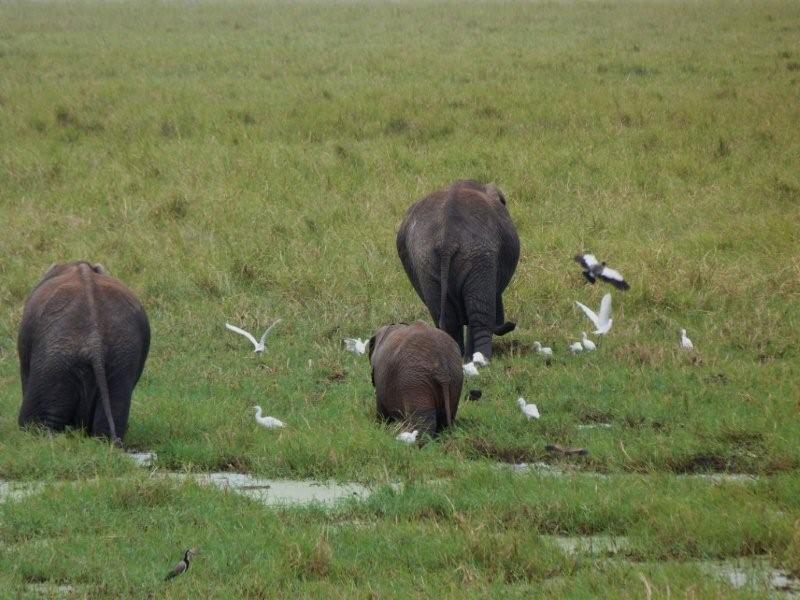 |
| Tarangire Elephants deep in the swamp keep the water open. Aug 2011 |
 |
| Open water created ideal habitat for water birds: Silale Swamp, Tarangire |
 |
| When you're tired of elephants you'd better stop guiding... Tarangire May 2011 |
Thursday, 1 September 2011
Why Are There So Many Wildebeest Compared to Other Animals in The Serengeti?
 |
| Herds crossing into Kenya. |
When you’re driving through hundreds of thousands of wildebeest, or watching tens of thousands plunge into the Mara river because the grass is greener on the other side, its hard to wonder why there are so many of them. Why not zebra, topi, kongoni, impala, dikdik or one of the other antelopes?
So, I thought I would explore this topic and discovered this wonderful paper online, which you can download if you want to read a more scientific explanation. (Click here )
Part of Colin’s themes has been that there are things that shape or influence the environment, and that the environment then shapes the species in it. It’s a two-way interaction that steers what happens. E.g. When there is predation on plants they evolve defense mechanisms like thorns or chemicals.
So, what is it about the Serengeti that promotes these massive herds of wildebeest?
The simple answer:
Climate and soils.
The Serengeti ecosystem extends between two geologically significant features:
In the east, are the rift valley volcanoes that blew volcanic ash over the eastern part of the Serengeti, starting millions of years ago. These became the extremely fertile short grass plains between Maswa and Piyaya.
 |
| The short grass plains of Piyaya- the volcanoes in the distance. |
In the west, Lake Victoria gives the north-western Serengeti a much higher rainfall (1200mm) than south-eastern Serengeti (500mm), especially when everywhere else is dry.
Put these two factors together and you have high quality grazing every month of the year. In the wet months of the year (Feb, March, April), the soils in the short grass plains make the grass particularly excellent grazing with extra dose of calcium and phosphorous - perfect if you are a wildebeest trying to make milk for your calf. In the dry season- well, you migrate to where its raining and you find green grass which is much more nutritious than dry grass. (Wildebeest need 30% more energy, 5 times as much calcium, 3 times more phosphorous and 2 times as much sodium when they are lactating than pregnant and the short grass plains are perfect.)
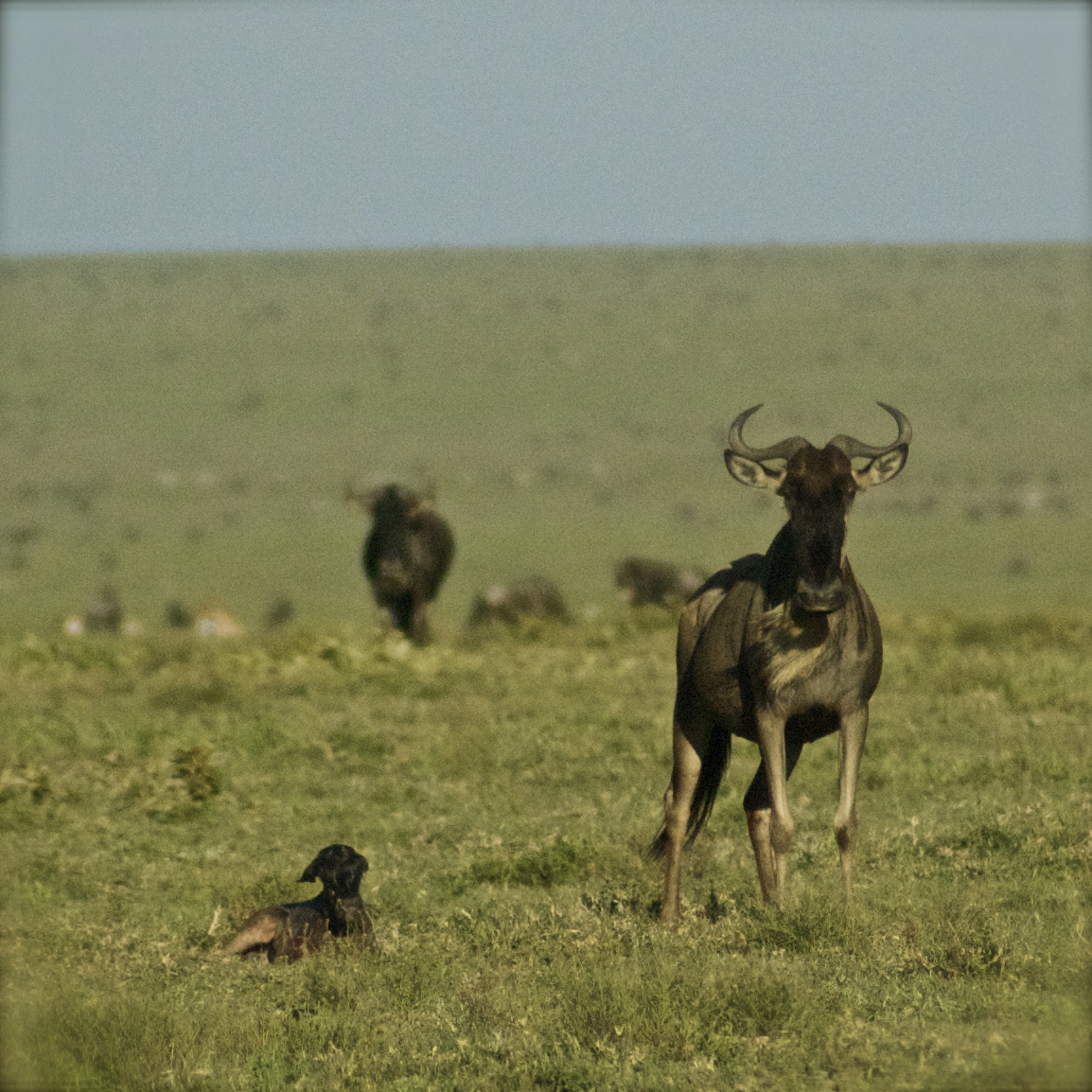 |
A newborn wildebeest in Piyaya. It stands within 20 minutes
to suckle. The milk is a high-cost to the mother but she survives because of the minerals in the grass. |
So, now we understand that the whole 25,000km2 Serengeti ecosystem always has nutritious grass (and drinking water) somewhere at all times of the year. The next question we have to investigate is- why wildebeest? Why not zebra, topi, kongoni, eland etc. etc?
The simple answer:
Wildebeest are special.
 |
| Topi in the long less nutritious grass on the Lamai wedge |
We can start by looking at the mouth structure of these animals and realizing that wildebeest actually have a mouth that is perfect for eating grass that is 3cm high, which is when the grass has the highest levels of protein.
The next thing they do is chose the parts of the grass that are also more nutritious- the leaves and fresh shoots. Coke’s hartebeest and topi eat more stems and leaf sheaths than wildebeest, zebra survive on almost only stems. But there’s a lot more grass stems than grass leaves so you would rather expect zebra populations to be in the millions but they aren’t- what is actually happening, is that zebras suffer very high losses of young, so predators keep zebra numbers down.
Now, you might ask, why aren’t wildebeest populations kept low by predators?
Answer: Synchronized reproduction and rumination.
80% of wildebeest calves are born in 3 weeks in February= 250,000 wildebeest calves= 500 per hour. It is an amazing sight. In scientific terms: extreme synchronous breeding outstrips predator’s ability to limit wildebeest recruitment.
Calves are most vulnerable when they are very young but they reach a certain age when they become equally vulnerable as the other wildebeest. There is a limit to how many calves predators can take per day, so by all having their babies at the same time, more calves have the chance to live past the age where they are vulnerable. Topi and hartebeest do not have as synchronized breeding as wildebeest.
 |
| Zebra on the extra nutritious short grass plains. |
As we mentioned before, wildebeest are ruminants. They spend about 8hrs a day grazing so they have 16hrs a day to look for predators. Zebra on the other hand, spend 15hrs a day grazing so they only have 9hrs to look for predators. This is because they are hind-gut fermentators. This is obviously simplified.
Now, we’ve established the benefit of synchronized breeding but there are other advantages to being a wildebeest. Serengeti’s short grass plains are the best place for the females to get the nutrients they need to lactate, but they are also a great place to spot predators, which also helps to reduce the number of calves killed before they are out of the vulnerable stage.
Finally, calves are born precocial with a very strong imprinting instinct. The mother and calf learn to recognize each other immediately by smell and the calf stands as soon as it can and then stays as close to its mother as possible. The calf then also tends to run on the hidden side of the female so that predators have a harder time seeing them. The effect= reducing predation.
 |
| Wildebeest calve's coats change color to look like their mothers at 2 months. Predation drops drastically. |
There are other minor influences and for more details download the paper, but to try to sum it up in a sentence: The Serengeti’s unique climate and soils provide the perfect conditions to allow wildebeest to live in such large migratory herds because of wildebeest’s unique biology.
Subscribe to:
Posts (Atom)