Showing posts with label Habitats. Show all posts

Thursday, 5 January 2012

Ecology of broad-leaved woodlands in the savannah

Terminalia Woodland, Sasakwa Hill, Grumeti Reserves, July 2009
We've covered a number of savannah habitats so far, but one we haven't touched on so far are the broad-leaved woodlands. On the one had that might seem surprising - broad-leaved woodlands of one type or another are the dominant vegetation of much of the savannah biome, but on the other hand and despite the area they cover, they're not the areas most safaris spend too much time in. The reasons for this are obvious if you do start driving around them - wildlife densities are much lower in the broad-leaved woodlands than in the grasslands and Acacia woodlands that form the other major habitats of the biome. Despite this overall pattern, however, some species are actually commoner in this type of habitat than elsewhere. So why is this, and what is special about the broad-leaved woodlands?
Our Nov training camp was in broad-leaved woodland nr Tarangire!

As usual, we'll answer these questions by reference to the savannah big four: water, nutrients, fire and herbivory. The most immediately obvious thing about the broad-leaved woodlands in savannahs is that they're usually found on the higher ridges of an ecosystem - as you move off a ridge you come through the broad-leaved woodlands (typically Combretum - Terminalia woodland in much of East Africa, though a lot of Brachystegia in the southern part of the region) and gradually enter a belt of Acacia woodlands and grasslands on the lower areas. As we should know by now, these ridges are likely to have very poor nutrient loads in their soils - the ridges are often of very old rocks, 550 Million years old or more and have been well and truly washed by rain for much of that time, with the nutrients that were once present now washed down hills to the lower areas where they get used by Vachellia/Senegalias and grasses. So life is pretty tough in these areas, whether your a plant or an animal that feeds on the plants. Nutrients are particular hard to come by, so growth rates tend to be lower and there's consequently less nutritious food around to browse, explaining the relative lack of wildlife in these areas. The lack of nutrients also explains why the leaves of broad-leaved woodland species turn yellow before falling, whilst those of Vachellia and Senegalia do not: plants with nutrient shortages will try and recover as many nutrients as possible from their leaves before they drop them, and as they withdraw nutrients, so the leaves change colour. By contrast Vachellia and Senegalia ('Acacias') are legumes and have a have an ample supply of nutrients so don't need to do this withdrawing so much before loosing their leaves at the start of the dry season. The comparative lack of browsing in these areas, of course, also explains why broad-leaved woodlands aren't as thorny as other woodland types - there's little nutrient, so there's little browsing, so there's little need to defend yourself from browsing in these areas.
Lesser Kudu are often in broad-leaved woodlands. Tarangire Aug 2011

Herbivory then, is reduced. It's far from absent, but it's definitely reduced - and mainly done by some of those animals that are less frequently seen in other areas: Greater and Lesser Kudu are fans of broad-leaved woodland, so too are eland, grey duikers and the like. Why is it that these animals actually seem to like spending time in the nutrient-poor broad-leaved woodlands? Well, on the one hand you could suggest that if they didn't eat there, nothing would and even though it's nutrient poor it would still be a wasted resource, and that's certainly true to a point. But also these animals are all mammals that aren't the best at dealing with predators - they'll usually run a bit, then freeze, which works well enough when predators are at low densities, but isn't going to be so effective on a plain, or where there are large numbers of predators. So it might be predator avoidance that drives these animals to the nutrient poor hillsides that othe animals avoid - though of course we've no way of saying if in fact it might be the other way around, that once you specialise on nutrient poor food you don't need to be so good at avoiding predation!
Tabora (long-tailed) Cisticola is often common in broad-leaved woodland

What of the other two processes, water and fire? Well, they don't tend to differ so much between broad-leaved woodlands and the 'Acacia' woodlands. Maybe a little less fire (the grass doesn't grow so well), and a little less water remaining on the shallower soils, but these differences are tiny compared to the major differences in nutrient availablity and herbivory. So, in the interests of simplicity, let's leave the broad-leaved woodlands there for today - interesting places to visit for specific animals and plants (and some nice birds too!) that specialise in these habitats, but not the main focus of many game drives.

Monday, 26 December 2011

TAWIRI conference discussions continued: Ruaha River

Wetlands, like Silale Swamp in Tarangire, are vital for feeding rivers
Returning to the TAWIRI conference back in December that I posted a bit about already, the other talk that set me thinking about economics of conservation was a fascinating talk by Eric Wolanski about ecohydrology. About what, I hear you ask?! Ecohydrology, the study of the interactions between water (hydrology) and ecosystems. Now it occurred to me that we've not done a post specifically about wetlands yet, which is a bit of a major ommission, given their importance in savannah ecosystems. We'll have to rectify that in time, but for now we're going to plunge straight into some important stuff.

Flows in the Mara River have been disrupted by deforestation in the Mau Forest
As we all know, the life-blood of a savannah ecosystem is its permanent water source(s). As we've talked about in our Serengeti Story, the Mara River is the only important permanent water source in the Serengeti Mara ecosystem, and the animals move a long way to get there. Tarangire has the Tarangire River. Ruaha has the Great Ruaha River, etc. What makes these rivers permanent and other rivers in the savannah only seasonal is that they're fed by sources that capture the rain in the wet season and slowly release it during the dry season, whilst sand rivers tend to just be rain fed. The Mara is fed by the Mau Forest in Kenya, Tarangire River by Silale Swamp, and the Great Ruaha by a series of wetlands, including those of the Usangu Flats. Meddle with these 'sponges' and you can get in all sorts of trouble with your permanent water sources.
Birds and other wildlife also love wetlands like Silale! Sep 2011

Eric told a fairly simple story, but a fascinating one none the less (especially when you start doing the sums that I've been looking at). If you have vegetation covering a waterbody, he said, the water loss through evaporation and transpiration (plant breathing) is about 50% of the evaporation you have from open water. Somore water flows from vegetated wetlands into rivers than from ones taht have lost their vegetation through excessive grazing. Which is exactly what had happened during the 1990s and 2000s on the Usangu flats, above Ruaha. Much of the water that flows from Usangu at the end of the wet season is the water that subsequently fills Mtera Dam, so keeping the water flowing - as well as providing a vital resource for the wildlife of Ruaha National Park - is pretty important for electricity generation in Tanzania! Uncontrolled (but illegal) immigration had allowed hundreds of people with an estimated 300,000 cattle to occupy the Usangu Game Reserve (as it was), and the cattle ate all the vegetation over the wetland. As a consequence the evaporation rates increased and less water flowed from Usangu into the Great Ruaha. In 2006 the government decided to evict these people and incorporate the Usangu Game Reserve into Ruaha National Park (in so doing creating the largest National Park in Africa), hoping to restore water flows, though among serious concerns about human rights. And Eric was able to watch the consequences in the flow rates through the Usangu flats and into the Great Ruaha river. Amazingly, this operation alone has resulted in the Ruaha river flowing for an extra month. Now that result is a great success for conservation, but it's not the end of the story by any means and I did some quick back of an envelope calculations of my own that are pretty staggering, but before we go there let me post a few caveats - firstly, I'm not a hydrologist and I'm just reading a few things quickly, I'm not guaranteeing these figures in any way. Also, as I've not always found the exact figures I've tended to err on the side of caution - for example, I've found statements that show dry season flow is unimportant to Mtera water levels (as you'd imagine), but that the dam mostly fills when the Usangu wetlands are flowing full rate at the end of the wet season, but I've not got the relative figures for this so I've assumed that the flow operates continuously - which should underestimate the importance of Usangu. Still, here are some interesting numbers...

Early in 2011 the IMF downgraded it's forecasts for growth in the Tanzanian economy from 7.5% to 6%, due to the costs imposed by TANESCO power cuts (up to 16hrs per day in much of the country!). Tanzanian GDP in 2010 was abour $23 Billion, so the cost to Tanzania of the powercuts, according to the IMF, is $345M. [Interestingly, that GDP is a tiny bit more than George Soros and family have tucked away, is similarly a tiny bit more than the value of the treasure recently discovered in the vaults of an Indian temple and is not even half the annual turnover of GlaxoSmithKlein!] Most of these power cuts were caused by low water levels in dams preventing power generation - Mtera dam (fed by Usangu through the Great Ruaha) feeds two power stations, Mtera and Kidatu, producing between then 284MW of power, which is about 40% of Tanzania's total capacity of 769MW (Thanks TANESCO for these figures). I've not found how many months the stations were going for, but I did discover that for the last few years the Ruaha has flowed for only 9 months, so let's assume it's similar. Now if we assume that 40% of the cost of the blackouts is caused by Mtera not producing (actually, I'm sure it's much higher since it's mainly the Hydro part of the production that's failing, but that's the proportion of overall capacity sourced by Mtera and will give a conservative estimate), those thee months of non-flow each cost the Tanzanian economy $46M. So the government's action to remove cattle, by providing an extra month's flow from Usangu, might well ahve saved about $46M per year. Not a bad investment, I think, even if they had paid the going rate of $150 per cattle the $45M required would have been paid off in one year and as it was many of these cattle moved elsewhere where they caused less damage to sensitive wetland habitats.

Now the final question you'll be asking, I guess, is what about the remaining 3 months of no-flow? How can we get that back? Well Eric and colleagues estimated that if the rice farms that are the other major water user returned only 25% of their water, there's be no problem at all. And I've just done a quick check and found that the estimated cost of completely closing the rice farming industry in this area would cost the national economy 'only' $15.9M per year. If that's what it takes to keep Mtera flowing, it doesn't seem a particularly hard decision for me, and think of the wildlife benefits too!

Anyway, I hope those figures are of some interest - it just goes to show that conservation really can be a 'win, win' option, even when hard decisions need to be made. Let's just hope it doesn't take too long before someone sees sense here - good luck to those people and organisations trying to build awareness of these issues!

Thursday, 1 September 2011

Why Are There So Many Wildebeest Compared to Other Animals in The Serengeti?

Herds crossing into Kenya.
Having been on safari for the last couple months, I’m unworthy of being called a co-author of this blog considering the wonderful posts that Colin has been writing. In my travels I have been to the Serengeti ecosystem four times in the last few months, three times in Serengeti and once in Maasai Mara and of course we have followed the spectacular herds of wildebeest.

When you’re driving through hundreds of thousands of wildebeest, or watching tens of thousands plunge into the Mara river because the grass is greener on the other side, its hard to wonder why there are so many of them. Why not zebra, topi, kongoni, impala, dikdik or one of the other antelopes?

So, I thought I would explore this topic and discovered this wonderful paper online, which you can download if you want to read a more scientific explanation. (Click here )

Part of Colin’s themes has been that there are things that shape or influence the environment, and that the environment then shapes the species in it. It’s a two-way interaction that steers what happens. E.g. When there is predation on plants they evolve defense mechanisms like thorns or chemicals.

So, what is it about the Serengeti that promotes these massive herds of wildebeest?

The simple answer:
Climate and soils.

The Serengeti ecosystem extends between two geologically significant features:

In the east, are the rift valley volcanoes that blew volcanic ash over the eastern part of the Serengeti, starting millions of years ago. These became the extremely fertile short grass plains between Maswa and Piyaya.
The short grass plains of Piyaya- the volcanoes in the distance.

In the west, Lake Victoria gives the north-western Serengeti a much higher rainfall (1200mm) than south-eastern Serengeti (500mm), especially when everywhere else is dry.  

Put these two factors together and you have high quality grazing every month of the year. In the wet months of the year (Feb, March, April), the soils in the short grass plains make the grass particularly excellent grazing with extra dose of calcium and phosphorous - perfect if you are a wildebeest trying to make milk for your calf. In the dry season- well, you migrate to where its raining and you find green grass which is much more nutritious than dry grass. (Wildebeest need 30% more energy, 5 times as much calcium, 3 times more phosphorous and 2 times as much sodium when they are lactating than pregnant and the short grass plains are perfect.)
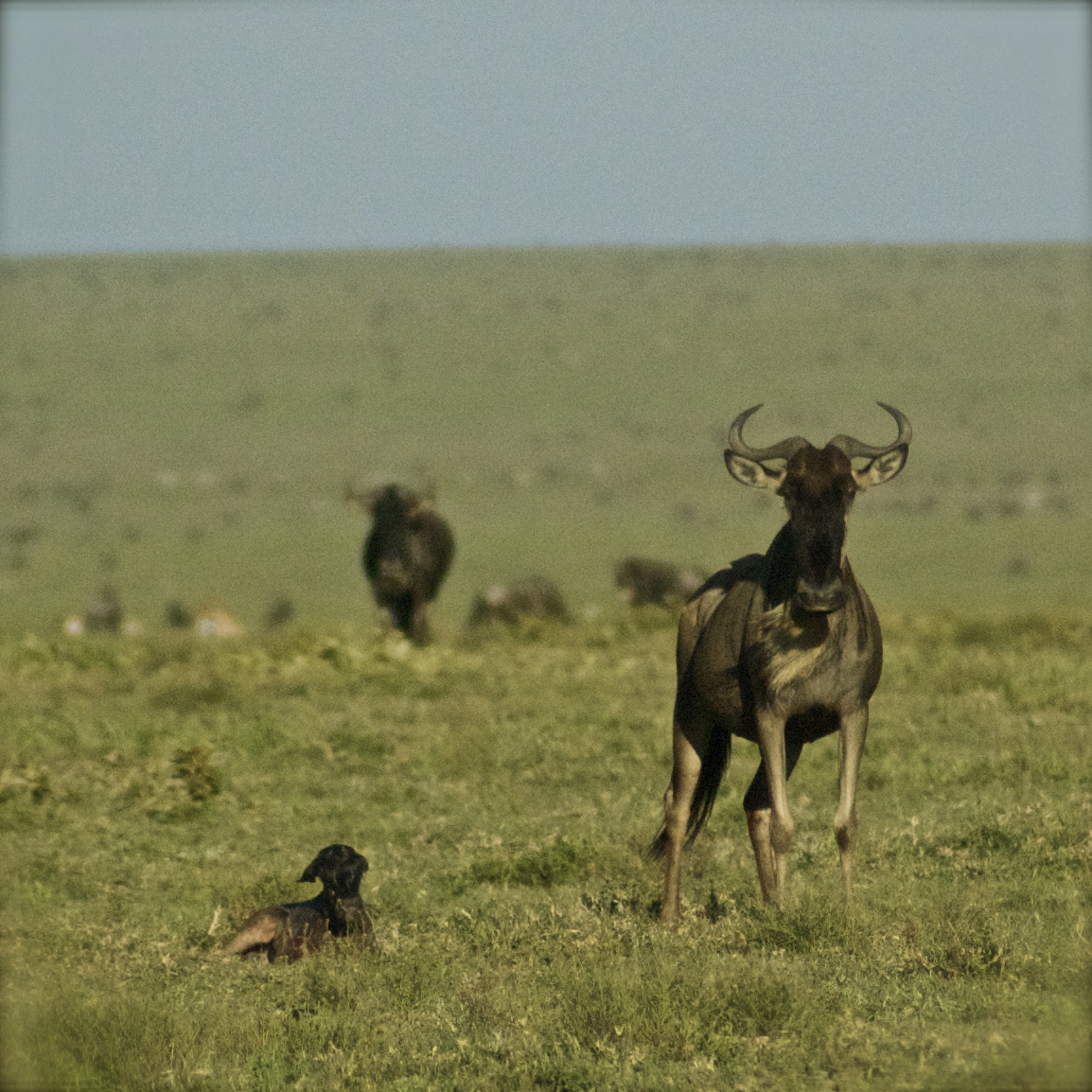
A newborn wildebeest in Piyaya. It stands within 20 minutes
 to suckle. The milk is a high-cost to the mother but she
survives because of the minerals in the grass.

So, now we understand that the whole 25,000km2 Serengeti ecosystem always has nutritious grass (and drinking water) somewhere at all times of the year. The next question we have to investigate is- why wildebeest? Why not zebra, topi, kongoni, eland etc. etc?
The simple answer:
                   Wildebeest are special.

As you might know, wildebeest belong to a tribe of antelopes called the Alcelaphines. This means they are fairly closely related and if you want to know how close, well, they are about 4 million–year-old cousins. All of them are ruminants, which means they have a four-chambered stomach that they use to digest cellulose. Rumination is a very efficient way of extracting nutrients from plants but each species will have it’s own efficiency and Coke’s hartebeest are actually the most efficient of the three species. So why isn’t it Coke’s hartebeest?
Topi in the long less nutritious grass on the Lamai wedge

We can start by looking at the mouth structure of these animals and realizing that wildebeest actually have a mouth that is perfect for eating grass that is 3cm high, which is when the grass has the highest levels of protein.

The next thing they do is chose the parts of the grass that are also more nutritious- the leaves and fresh shoots. Coke’s hartebeest and topi eat more stems and leaf sheaths than wildebeest, zebra survive on almost only stems. But there’s a lot more grass stems than grass leaves so you would rather expect zebra populations to be in the millions but they aren’t- what is actually happening, is that zebras suffer very high losses of young, so predators keep zebra numbers down.

Now, you might ask, why aren’t wildebeest populations kept low by predators?

Answer: Synchronized reproduction and rumination.

80% of wildebeest calves are born in 3 weeks in February= 250,000 wildebeest calves= 500 per hour. It is an amazing sight. In scientific terms: extreme synchronous breeding outstrips predator’s ability to limit wildebeest recruitment.

Calves are most vulnerable when they are very young but they reach a certain age when they become equally vulnerable as the other wildebeest. There is a limit to how many calves predators can take per day, so by all having their babies at the same time, more calves have the chance to live past the age where they are vulnerable. Topi and hartebeest do not have as synchronized breeding as wildebeest.
Zebra on the extra nutritious short grass plains.

As we mentioned before, wildebeest are ruminants. They spend about 8hrs a day grazing so they have 16hrs a day to look for predators. Zebra on the other hand, spend 15hrs a day grazing so they only have 9hrs to look for predators. This is because they are hind-gut fermentators. This is obviously simplified.

Now, we’ve established the benefit of synchronized breeding but there are other advantages to being a wildebeest. Serengeti’s short grass plains are the best place for the females to get the nutrients they need to lactate, but they are also a great place to spot predators, which also helps to reduce the number of calves killed before they are out of the vulnerable stage.

Finally, calves are born precocial with a very strong imprinting instinct. The mother and calf learn to recognize each other immediately by smell and the calf stands as soon as it can and then stays as close to its mother as possible. The calf then also tends to run on the hidden side of the female so that predators have a harder time seeing them. The effect= reducing predation.
Wildebeest calve's coats change color to look like their
mothers at 2 months. Predation drops drastically.

There are other minor influences and for more details download the paper, but to try to sum it up in a sentence: The Serengeti’s unique climate and soils provide the perfect conditions to allow wildebeest to live in such large migratory herds because of wildebeest’s unique biology.


Wednesday, 17 August 2011

Kopjes


Moru Kopjes, Serengeti, Jan 2011 - stacked boulders form by erosion around cracks
One of the prettiest things about Mwiba is the large number of kopjes (pronounced 'kopees') found down here. Massive and ancient, the rocks that form kopjes are great added value in many safari destinations. They also form an important part of the landscape and should never be seen simply as a photogenic backdrop, or a great place to enjoy the sunset! 

Mwiba kopjes give a good view! Jan 2011
In fact, geology is one of my 10 things to talk about, and there's no more obvious prompt to talk about geology than when sitting on a kopje. But if you're going to do that, it's important you know something about them before plunging in. If you want a really good overview of the soils and geology of the Serengeti ecosystem, you'd do no better than looking here, this is more of a general overview and whilst mostly focussed on the Serengeti ecosystem, the processes involved are similar across Africa and it shouldn't be too hard to find out the location specific details once you understand the process if you want other areas. 

So, what is a kopje, geologically? Essentially, it's a pile of ancient rocks that protrude through the more recent soils and surface rocks – that's what gives them their other name of inselbergs: 'mountain islands'. In Serengeti they're either gneiss [pronounced 'nice'] (a metamorphic rock that looks rather like granite but doesn't have the little flat crystals of mica or similar – some gneiss has originally been formed from granite) or diorite/granite. And they're all OLD! The kopjes of the north west are the oldest and those of the western corridor the youngest, but all are Precambrian, which means over 500 million years old. Compare that to the volcanic ash deposits they poke through on the Serengeti plain, which are only 3million years old, and you see how different they are. All originally formed under the surface of the earth from volcanic activity that didn't make it to the surface, cooling below ground, and then over the ensuring millions of years the surrounding softer rocks have eroded, leaving the harder metamorphic or igneous rocks to become exposed as they are today.
Figs on a Mwiba kopje, Aug 2011
Horned Rockdweller, Bradinopyga cornuta, perhaps a surprising rock specialist!

Gloriosa superba the Glory lilly are common on kopjes: Naabi, Jan 2011


Klipspringer, a kopje specialist. Kruger May 2011
So, that's what they are and it's a good start on geology (though there's much more to talk about there too). But what about the role they play in the savannah ecosystem? In thinking about this it's first of all good to remember that they're a pretty unique habitat, with a specialised group of animals and plants. Kopjes are the place to find klipspringer and hyrax, they're also the only place to find one or two more esoteric bird species like rock-loving cisticola. Rock figs, as the name suggests, are common on kopjes but not many other places. As well as these really rather specialised species, there are a number of species here that are more often associated with riverine vegetation: there's a range of figs, you'll often see tamarind on kopjes and plenty of the animals often found by rivers are there too – both kopjes and rivers are great places to find leopard, for example. Why's this? Well, we need to think about the savannah 'big four' again, and how kopjes affect them.

(1) Water availability: you might think kopjes are dry barren places, but not at all – whilst the rocks are definitely dry, there are often hollows and cracks within them that keep the water for a long time. Figs are particularly good at sending roots over rocks to find the damp pockets and grow really well in such wet places. Animals and birds often know about the puddles too and will use them throughout the dry season, allowing water-dependent species to utilise areas of savannah that would otherwise be too dry for them.

(2) Grazing/browsing: ever seen an elephant on top of a kopje? A giraffe? No, me neither. Whilst there is a specialist browsing community of bush hyrax and klipspringer, for example, the huge impacts of mega-herbivores are minimal on kopjes, allowing plants that are poorly defended to thrive in a way that they can't manage on the flatter plains.

Bush hyrax and Mwanza Agama share this kopje! Moru, Serengeti, Jan 2011
(3) Fire (my favourite of course!): Yes, kopjes are fire breaks – large areas of bare rocks obviously can't burn and plants growing in the gaps in the rocks are safe from fires. As we know fire can be the main process determining whether there's forest or savannah in the wetter areas, it should be no surprise that the fire refuge offered by kopjes should have a forest type vegetation.

(4) Nutrients: just as the bare rocks allow water to concentrate in hollows and cracks, so nutrients from hyrax dung, baboon dung, leaf litter and all the rest concentrate in the cracks too, providing a relatively nutrient high (though thin) soil for those plants that can get to it. What's more, several animal species (like leopards hunting the plains, but bringing their kills back to the trees on the kopje, or eagles nesting on the crags but foraging over a wide area) use the kopjes at certain times of day or night and the plains at other times, but bring their food (and/or dung) back with them to the kopjes, further concentrating nutrients on the kopjes and resulting in a net flow of nutrient out of the surrounding plans, onto the kopje on a truly grand scale.

So, with all of the big four savannah processes being substantially different on a kopje from the surrounding landscape, it should be obvious that there's going to be a big difference in the ecology of the kopje, just as we see. And as the differences are mostly fairly similar to those in a healthy riverine area, it's not surprising that some of the elements are shared between the two otherwise rather different habitats.
Simba on Simba Kopjes, Serenegti. Jan 2011

As one last thought to leave you with, I've already mentioned how kopjes can be seen as a large-scale nutrient pump, pulling nutrients out of the plains and focussing them on the rocks, but there's one other big way in which they alter the ecology of the surrounding plans: predators. Just as leopards like kopjes, so too do lions. They're great places to warm up in the morning or evening sun, and provide an ideal viewpoint to survey the plains for food. Moreover, the rocks and thicker vegetaion make it much easier to sneak out and ambush your prey. So kopjes have a real impact on the 'landscape of fear' if you're a tasty antelope. Out on the short grass plains you've got a great view and it's tough for lions and the like – the plains prides of Serengeti have a home range over 200km2, compared to only 15km2 in the woodlands around Seronera (no wonder they're easy to find there!). So if you're a wildebeest, zebra or kongoni, you'd be wise to avoid the immediate area of kopjes – just as they do a lot of the time. And removing that grazing pressure from the plains around the kopjes, of course, is going to result in a changed ecology of the grasslands there too. So the impact of kopjes spreads out far wider into the landscape than just the rocks themselves. All very interesting – and easy to see whilst sitting about waiting for the sun to set!
Mwiba sunset from a kopje, Aug 2011

Monday, 1 August 2011

Coastal Habitats

Common Sandpiper on mangrove creek
So, in what's probably going to be the last coastal blog until I get back to the beach again, I thought I'd give a first introduction to some of the interesting coastal habitats. (Note the logical progression - off stuff in the sea, interesting things on the shore, and now interesting things on the land but near the sea. Anyone would think I had it planned!) So, let's start by thinking about what's down by most beaches. And in East Africa you don't have to spend long before realising it's basically a mixture of coconut plantations and sisal estates, with a bit of cashew thrown in for good measure. So you won't be surprised to learn that the northern coastal regions have some of the highest population densities in Tanzania (here), though to be fair most of the plantations were originally started by colonial Germans and Brits some time ago. So the remaining native habitat fragments are in a rather bad way, and can be hard to find. They are worth seeking out, though, as ther are some special things living in them.

For the purpose of this post, I think I'm going to focus on the two of the most interesting coastal habitats: coastal forest and mangroves. Coastal forest has obvious functional similarities to forests elsewhere in Africa, though the species composition can be pretty different. Mangroves, on the other hand, have no inland analogues, so let's start there.
Mangroves still do grow on open coasts here north of Pangani

If you've not seen them, mangroves are starkly different to any other habitat. They're mainly tropical in distribution (there are some in the Australian temperate zone, and a few on the East Coast of the US, but these are the exception that prove the rule), and once upon a time would have occured on any tidal zone (ie, on land covered by the high tide, but exposed at low tide) with a minimal degree of shelter from the full force of the sea - they used to cover over 3/4 of tropical tidal areas. At one time, that included even rather isolated islands like Maziwe, but now you'll rarely find them on the beach front themselves, but mostly limited to tidal creeks. And you'll know when you find one, because you'll be walking through the coconut plantation and suddenly hit a dense, dark and glossy thicket growing like a wall out of the bar mud or sand (sometimes even rock) substrate.
Mangrove edge in cocnut plantation, Ushongo Beach July 2011

If you can make your way through the mangroves, you'll see some interesting sights. Down on the ground the most obvious things are the arial roots - sometimes poking up like fingers, other species rely on multiple branches from the stem. These have a wonderful scientific name - pneumatophores - and their purpose is simply to allow the plants absorb air. But they also form a unique and busy microhabitat of their own - a mini-forest that traps passing mud and can harbour much richer muds than surrounding areas as well as providing lots of nice little places to hide from predators. Consequently, the root systems of mangroves are home to lots of life - there's always crabs to see, and in areas nearer to low tide limit there are often air breathing fish called mudskippers, which are kind of neat and perhaps remind us of our distant ancestry... What's more, these root systems are often extremely important nurseries for the young of reef fish important in many local fisheries.
Aren't those roots odd! Mangrove pneumatophores, Ushongo Beach

These pneumatophores aren't the only interesting adaptations of mangroves though - not only do the have to survive in water-logged soil, but it's very salty too (and in areas where shallow seawater sits around in the hot sun the concentrations of salt can be extremely high) and most plants can't tolerate salt. Mangroves have a number of adaptations to help, of which the most obvious is the glossy, thick leaf itself which reduces water-loss. But more fundamental are adaptations to the root that we can't see that simply filter the salt out of the water - by the time water arrives in the root, 82 - 97% of the salt has been filtered out. Given how difficult we find it to extract frest from salt water mechanically in desalinisation plants, that is a remarkable adaptation! And then what salt does get into the plant can be collected and excreted through the leaves, giving them a silvery appearance at times.
These roots also  absorb air in another mangrove species, Ushongo Beach

In such harsh environments, it's going to be particularly tricky for seedlings to thrive, so mangrove species have another neat adaptation up their leaves - they're (mostly) viviparous. What? Live-bearing plants?! Yes indeed, most mangrove species don't immediately drop their fruits, but retain them on the plant whilst the seedlings develop to a stage where they can photsynthetise themselves - some seedlings growing entirely inside thr fruit, others growing through and out. Then, when they're ready, the plant drops them either like a dart into the mud below them, or into water to float the seas until washed up in some suitable substrate, when the young plant is ready to go. Which explains why many mangrove species have extremely large distributions, dispersing on cross-oceanic currents.
Mangrove fruits germinating on the plant and ready to fall.


So, that's the structure of the mangrove, and it's obvious that this sort of harsh environment is going to be home to species of plants that are survivors - all their obvious competitors are eliminated by the environment itself. And just as the roots are home to lots of little beasties, the trees themselves are home to a pretty good selection fo birds and animals too. The really special bird to look out for in this area is Mangrove Kingfisher, but the mangroves can often be full of mixed species flocks of starlings (mainly Black-breasted), barbets and greenbuls, etc. Some great birding to be had if you can see into the thickets!


So, all in all, mangroves are wierd but great coastal habitats. And it's a shame there aren't more of them, because they are fantastically useful to us too, not least through their very impressive abilities to mitigate against the impacts of tsunamis.


Hmmm. Well, seems like this is probably a long enough post for now anyway, so coastal forests can wait for another time. Ecologically, they're rather similar to other forest types anyway, even if the species they hold are sometimes very different!

Tuesday, 19 July 2011

Connecting forests and savannahs

Pre-montane forest - note the high diversity of tree species, Lake Duluti, July 2011
In my last post I said I's intended to talk about the connections between forests and savannahs, but got distracted by pretty birds. So I thought I'd do it now instead, becuase it's still an interesting topic. Once upon a time, a surprisingly recently time ago, there were rather more forests in East Africa than there are today: even in the relatively well-wooded Eastern Arc mountains, it seems like nearly 80% of the prehistoric forests have been lost. And they were an important part of the landscape - both in their own right (harbouring massive biodiversity with hundreds of plant, vertebrate and invertebrate groups endemic to the Eastern Arc), but also through the role they play for many savannah animals.
Montane forest in Arusha NP is kept open by grazing and browsing - that's a C3 grss understory. June 2011

We've already seen that forest and savannah can both occupy areas where the rainfall is over 1000mm per year, and that fire seems to be the key factor determining which actually wins out. We've seen how riverine forest is a forest habitat within the savannah biome, and we probably also know that thickets are fairly similar too. But true forests are different, and we don't usually think of them as connected to the savannah at all. Yes, forests are different - they're not dominated by C4 grasses (though they can still have some pretty thick understory of C3 grass) as we've seen defines the savannah biome, but I think this distinction is unfortunate as they are connected, at times vitally so.
Forest C3 grass species - short, round leaves are typical. Duluti July 2011

Yes, it really is a grass!

For example, the loss of forest in the Mau escarpment that feeds the Mara river is believed to be responsible for the altered hydrology of the Mara river within the Serengeti-Mara ecosystem - less forest means less water is soaked up by the landscape, so more flows down the river in the wet season and less remains to flow during the dry season. More directly, East African forests provide homes for many of the species more typically associated with savannahs. You might not visit Arusha NP to see the elephants or buffalo, but they're there. And what's more, those elephants move - they go down the Ngara Nanyuki river and down onto the savannahs of West Kilimanjaro. Where, of course, they must meet elephants that have done the same from the forests of Kilimanjaro and those that have come out of Amboseli. The same seasonal movements of elephants into and out of forests is a regular pattern, whereever such movements remain possible. Typically, savannah elephants will move into the moister forest habitats during the dry season when food becomes scarcer and poorer quality on the savannahs. But elephants aren't the only animals making this movement - in other areas where the savannahs are moister than around West Kili, buffalo and several other species make the movements too, though it's usually a shorter-distance movement and less seasonal.
Buffalo (and other forest mammals...) Arusha NP, December 2009

We all know of the regular movements and migrations of many ungulates. This is usually driven in part by the need for dry-season forage (we'll have to post more about migrations later). But what's interesting even about the well-known Serengeti migration, if that's its variable both in route taken, and timing. And the key driver is food and water availability - if there's food and water around, the animals stay longer, if they see/smell rain somewhere else, they shift their routes to exploit it. This is a very sensible response to living in a highly variable environemnt, and it seems that many savannah animals are similarly flexible when they need to be, even if they don't show large-scale and well-known migrations. So the forest and thickets of the northern Mara can be heaving with wildlife during droughts, and provide an important buffer for animal populations when conditions get really harsh. Indeed, the loss of forest in Amboseli is believed to be one of the key changes that meant the drought there in 2009/10 had such a serious impact. It seems that many animals have their regular dry-season refugia (often wetlands like Silale in Tarangire) but if these dry up in a really bad drought, they'll move to the nearest forest and tough it out there. But if the forest patches have disappeared - particularly the lower-elevation forests - or are now separated by fences, then the animals can't do this ocassional movement and there's going to be trouble. So although true forests aren't usually considered part of the savannah biome, they certainly have a role to play in a well-functioning ecosystem. And what's more, they're a great change from the savannahs for visitors to East Africa, so don't avoid them just because you won't find lions there!

Sunday, 10 July 2011

Riverine forest- forest in the savanna biome

Majo Moto near Boma Ng'ombe - thick riverine forest is protected from browsers and fire

I spent the weekend with my family and friends camping at Maji Moto near Boma Ng'ombe. As the name suggests, this is a hot (well, warm at least) spring in the middle of some pretty dry Acacia – Commiphora scrub. There's a pretty impressive flow of somewhat warm water out of a cave forming a nice river that, as you might imagine, if a complete contrast to the surrounding dry, and it inspired me to think about riverine forest again. Already this year, it's pretty dry in lots of places (though I hear there's rain in western Serengeti), and everywhere is pretty dusty and dry. Except, that is, the riverine forests. Here the trees are still green, there's plenty of shade and the contrast is amazing, but this is just a hint of how different riverine forests will be from the surrounding vegetation in another couple of months as the dry season starts to bite.

Acacia commiphora scrub in the foreground with tall, green riverine forest in the back. Maji Moto, July 2011
So, where are riverine forests special and what role do they play in the savanna ecosystem? The first special thing that's immediately obvious is that they're green, when no-where else is. Ti understand what makes riverine forest special we're going to think again about nutrients, fire, water and grazing.browsing, the big four of the savanna ecology world. Lots of riverine trees are evergreen, or nearly so. And the reason they can keep green is that they typically have incredibly deep roots, penetrating right down into the water-table. With a few exceptions, the surrounding Acacia and Commiphoras tend to have shallow roots, spreading horizontally just below the surface of the soil, spread out and designed to catch as much of the water that falls on the surface as possible, very different from the tap roots of the evergreen riverine forests. Tap roots only work if the water table below ground isn't too deep, and alongside rivers that's fairly likely, so water-availability is the main factor altering the ecology of riverine forest.

Look closer and you'll notice some other things – trees of the riverine forest are often not thorny, in complete contrast to the surrounding vegetation. Now why is this? Obviously thorns are to do with defence against herbivory, so something about these trees means they somehow escape herbivory in a way that the surrounding habitats can't. That's odd, given that rivers are generally excellent places to find animals. So the key here isn't that the herbivory is much lower than in the surrounding woodlands, but that the tree growth rates are much higher and the trees themselves are larger, all thatks to that ready availability of water. So once established, riverine trees can grow all year around, escaping from even the tallest giraffe in a fraction of the time water-limited plants in other habitats need. So although the animal densities can be high, the impact of herbivory is less, at least on mature trees. Now that is a problem for seedlings, of course – although they grow fast, they still need to escape heavy herbivory whilst they're short, and this the achieve by heavy reliance on nurse plants – plants of other species (bushes and shrubs) that are well defended against herbivores, but that allow the seedlings of the riverine species to sneak in among them and also escape herbivory. Once the forest is dense, of course, the mature riverine forest can be so dense (especially if there's a dense palm understory that nothing can get into) that herbivores are basically precluded anyway, making regeneration of the forest fairly straight forward. So herbivory also plays a part in the riverine system.

And finally, fire is a big issue in riverine areas. Typically, trees of the riverine forest (like other forest – and riverine really can be a forest habitat attracting many species typical of more montane habitats, particularly in our current cold season) are fairly sensitive to fire. That's not much of a problem for them in general though, as they're usually green and moist, dense and with little grass in the understory (especially if there are lots of buffalo around keeping it short around their preferred river habitats), so don't have lots of dry fuels waiting to burn. In fact, riverine forests can play an important role in fire suppression, allowing different fire regimes on one side of a forest strip to the other. This sensitivity, however, causes a problem if you burn an area too much so the nurse plants are burnt off (one of the reason we think many of Serengeti's riverine forests are currently on the way out). And once recruitment is lost in this system, it's really difficult to re-establish riverine habitats, as the natural fire suppression is lost, and the herbivores are also given much better access. A savanna with healthy riverine forest is therefore likely to be well managed savanna.
Otolemur garnettii, common in Riverine Forest. Maji Moto July 2011

Figs are a valuable year-round food resource in riverine forest

Fallen ones are eaten by everything!
 And riverine forest is, of course, a vital habitat for many species. I've already mentioned the fact that buffalo like to hang out in these areas, and they have their own set of animals too. They're great places in the shady spots to find leopards, or you might look for some of the more specialised riverine species too – lots of good birds, loads of bush-babies and maybe tree hyrax, etc. Obviously many game drives take in riverine forest, particularly in the dry-season when they're the only green areas around, especially as they're one of the only habitats at this time that has fruit on offer – figs are everywhere in the riverine forest, and there's always some ripe somewhere nearby. Figs are on all rivers, but up here Tamarind is a pretty specialised riverine tree too, and you'll often find Marulas on the rivers too, all excellent food sources for monkeys, baboons and birds, plus the fallen fruit are loved by bushbuck, elephants and just about anything really! At this time of year when food is hard to find in the open savanna, riverine forest really comes into it's own and lots of animals will make extra use of the habitat during the dry season. All in all, a very important part of the savanna ecosystem, both through proving food resources, but also from it's role as a fire break, etc. And you can have lots of fun in the river too!

Many special birds are easiest to find in riverine forest – a Pygmy Kingfisher, July 2011
In the cold season
higher elevation forest species like these Black Saw-wings follow rivers into the lowlands

Saturday, 11 June 2011

Acacia woodland

Next on the list of major savanna habitats must be the Acacia woodlands. The sun setting behing a lat-topped acacia provides one of the iconic images of an African savanna, and many of the most interesting game drives involve meandering through Acacia woodland. In fact, there are a very large number of Acacia species in Africa - something over 150 - and they're al a little different (let's ignore the current taxonomic discussions about Australia taking the Acacia genus for it's species leaving the African's with none...) . Ecologically, Acacia species play a vital role in the savanna ecosystem, but before we think too much about that, let's start by thinking about why Acacia woodlands are found where they are.
They make great backdrops, even for Flamongos! Lake Magadi, Serengeti NP Jan 2011

First, of course, we need to identify where the Acacia woodlands are and it's obvious if you're looking for it: Acacia woodlands are typically found on the lower slopes of hills and on the flatter land at the bottom of valleys. On the ridges there are generally broad-leafed woodlands, such as Terminalia and Combretrum woodlands, or in areas with a single rainy season you might find Miombo woodlands on the ridges. Boardering rivers, of course, you often find true riverine forest, another habitat again (although one that often features Acacia species). But between the riverine forest and the broad-leaved woodlands is the area where grasslands and Acacia woodlands are commonest. And the reasons for this position are probably to be found on those four main drivers of savanna ecology: fire, nutrients, water availability and grazing pressure. On the ridges, nutrients are very scarce thanks to millenia of washing by heavy tropial rains. Lower down there are more nutrients, but in consequence the grazing/browsing pressure is going to be higher - to survive in these areas you need to be very heavily defended - like the big throns on many Acacia species. The soil moisture content is also important: like other members of the Fabaceae (peas and beans being obvious examples, of course), Acacia species have a symbiotic relationship with nitrogen fixing bacteria (called Rhizobia) that live in nodules in their roots, and these bacteria are somewhat fussy about where they live. (In fact, they can life in soil away from the plants, but they are unable to fix nitrogen in isolation.)

This relationship with Rhizobia is responsible for what is probably the most important role Acacia woodlands have in the savanna: they're incredibly important nutrient pumps. Thanks to their nitrogen fixing bacteria, Acacia species have a pretty much unlimited supply of organic nitrogen, vital to producing proteins and growth. In the generally rather nutrient poor soils of Africa, this has a massive impact. All the browsers love a snack on the nutrient rich Acacia leaves, despite their thorns and high tannin content. But most importantly, at the end of the wet season Acacia trees drop their leaves like most other savanna plants - but because they have such a plentiful supply of nitrogen, they don't bother withdrawing all the nutrient before they do so. This is immediately obvious if you drive the savanna at this time of year: Acacia trees remain greenish right until the leaves fall, other broad-leaf species withdraw as much nutrient as possible, resulting in yellow or orange leaves, before they fall. And the consequence of this is that Acacia leaf litter is much richer than the little of other species and fertilises the soil under the trees. So effective is it, that in some places Acacia litter is used as a major fertiliser for poor soils.

Again, the impact of the richer soil is immediately obvious if you go and look under an Acacia - there's a whole lot more diversity in the herb layer than under a neighbouring non-Acacia species.
Lots of herb diversity in the understory of an Acacia woodland thanks to the fertilisation effects. Near Mbalageti River, Serengeti, Jan 2011.
Not much under a Balanites but grass (oh, and a few animals) - Grumeti GR, Sep 2010
This diversity, combined with the fertilisation effect making everything rather more nutritious than elsewhere in the savanna explains the reason you spend so much of your time on game drives in Acacia woodlands: everything loves them! Of course, the problem with this is that it attracts lions and other predators who hunt much more efficiently from the cover of woodlands, so if you're a browsing animal you've got to choose: do you got for the nutrient rich woodlands and under-story of the Acacia belt but face the higher risk of being eaten yourself, or do you avoid the richer habitats and forage in safer places where you can keep an eye on predators much more easily? If you're sensible, of course, you'll probably balance the two options up and make decisions based on exactly how much you need those nutrients at any one time – early in the dry season there's plenty of forage in the open grasslands and you've had plenty of nutrients recently during the wet season anyway, so you might spend more time in the grasslands. Later in the dry season those open areas may have been grazed to nothing and you're more in need of nutrients as you might well be preparing for pregnancy, so you might decide to take the risk and forage in the woodlands: at different seasons, different strategies make most sense and within the savanna ecosystem such movements are very sensible. Of course, you might also decide to just live on the woodland margin – nipping into the woods when you're fairly sure there are no predators around, but in easy reach of the open areas if you're more worried. This, of course, means that those ecotones – the transition from one habitat (Acacia woodland) to another (open grasslands) – are going to be fantastic places to explore on your game drive.


And that, for now, is probably enough about Acacia woodlands. There's lots more to say about both Acacias and the woodlands, but as an introduction to the habitat it's not a bad place to start.
Acacias do make for nice sunsets! Here some herons roost on a bit A. tortilis near Lake Ndutu, Serengeti, Jan 2010

Thursday, 2 June 2011

Grasslands

They're the thing you probably think of first when you start thinking of savannah habitats, so probably a good place for me to start too. As we've already said, savannah is defined by grasses and all the grazing animals (by definition) depend on grass to a greater or lesser degree, so there must be something interesting to be said about grasses. Surely?! Not one of our guides in training had ever been brave enough to tell their clients about grass though, so certainly room for improvement.
Only ecologists could wander around Serengeti looking for grasses, surely?!

So, what is there to say? Well, it's probably worth first wondering why grass is so popular with so many animals, and how it survives being eaten all the time? The answer to the first part is probably as simple as there being a lot of grass out there, so clearly a niche waiting to be filled. The second is, perhaps, more interesting, even though we all know it anyway: the growing tip of grass is right at soil level, so you can eath the tips without damaging the growing point - not like most other plants at all. This is clearly a great evolutionary advantage for grass - the first grass that grew from the bottom must have had a much easier life than the other plants around. But it also raises the interesting prospect that, once evolved, the plant may actually harness grazers to keep the environment suitable for itself. The main competition grasses face on the savannah is from trees for water and (probably to a lesser degree) light. If grazers munching on grass encourage those same grazers to occassionally nibble (and thereby seriously damage) the seedling acacia nearby without suffering any serious cost themselves, they've effectively harnessed the animals to keeping the environment suitable for grasses. Neat trick for a bit of grass, huh?! Further more, we think there's a chance grasses may have also evolved flamibility for the same reason - by encouraging fire in the ecosystem (and grasses always carry the fires from place to place in the savannah), they keep seedling trees out of the picture in grasslands. As they suffer little from fire, this is again a neat trick (if it's true - there's some debate still, but the topic is an interesting one all the same!).

And then, despite first apperances, there's grasses and there's grasses. Which is to say, not all grasses are the same. In fact, there are somewhere between 9 and 10,000 grass species, depending on who's counting. And that includes (in only eight grass species) 70% of all crops - maize, wheat, sugar, millet, rice, etc. are all grasses. So there's somthing interesting to begin with!

Given the incredible diversity of grass species out there, it's no surprise that for grazing animals there are some pretty serious differences too, particularly in the dry season. One of the most important ecological divisions of grasses is into the two groups or "Sweet grass" or "Sour grass" - the familiar sweetveld and sourveld for our South African colleagues. This fundamental distinction is based on what the grasses do to the nutrients they've captured during the dry season. During the dry season all grasses stop growing and most above ground parts die, life remaining only in and near the roots. Indeed, for annual grasses, the entire plant dies during the dry season. But plants preparing for the dry season have two options - either they withdraw all the nutrient they can into the roots, leaving a very poor cellulose only dry matter in the dry season, or they don't and the nutrients remain available above the surface during the dry season. Obviously, grazing animals will prefer the latter. In general grass species do one of these or the other, but a few adapt their strategies slightly depending on how nutrient rich the soil is, being less careful about the nutrient that gets left to grazing animals in areas where the soils are richer.

This fundamental distinction between strategies for preparing for the dry season has huge impacts in grazing animals. Indeed, there's some evidence that the (now largely extinct) large mammal migrations of South Africa were primarily driven by animals leaving the sourveld in the dry (winter) season and moving to areas with better dry season grazing options. The same impacts can be seen in many areas of East Africa too.

This is far from the only difference between grasses, however, as even during the wet (growing) season there are considerable differences in the nutritional content of grasses growing in different soils. In particular, grasses growing on the recent volcanic soils associated with the Rift Valley (famously the short-grass plains of southern Serengeti and Ngorongoro, less widely know being the Simanjiro plains north east of Tarangire NP, etc.) are particularly rich in nutients. Indeed, it is largely the search among pregnant and lactating female wildebeest and zebra for grasses rich in Calcium (needed for growing healthy bones in particular)  and Phosphorus (needed for growth in general) that drive the famous migrations, with calving occurring precicely when the animals can use the nutrient rich grasslands in these areas.

Grasses can also be beautiful!
The other main variable that determines how palatable a particular grass might be is, of course, how well defended it is. Grasses use silica, a natural glass, to defend themselves - it's what makes grasses sharp enough to cut you as you walk past some. But not all species are as well defended as others, and (perhaps even more importantly) at different stages of growth the same plant may be better or worse defended. Silica takes time to produce and deposit once growing has begun, so new growth - as well as being rather nutrient rich - is typically rather poorly defended. Which is great for grazers! So you often find that once an area has attracted a number of grazers and they've kept it free of old, well defended course grasses, a grazing lawn develops where, just as in our garden lawns, as soon as the grass gets a bit high (and starts to defend itself), something comes along and chops the top off. In East Africa these grazing lawns ocur comonly on particularly rich grasslands (indeed, the whole of the Serengeti's short-grass plains may be a grazing lawn), but also on a smaller scale around local nutrient sources, like termite mounds. It's incredibly easy to find them at the end of the wet season, where most grass is tall, except at the grazing lawns. And a nice feature to point out, once you start seeing them. Interestingly, in areas with Hippos, grazing lawns are really common by rivers, they're very good at forming them. But in the few places where White Rhino are still relatively abundant they also play a very important roll in opening and maintaining grazing lawns that are then also utilised by many other species - this is a process that is now (sadly) lacking from many parts of Africa, and we can only wonder about the overall impact.
Grazing Lawn in Kruger, May 2011 - note characteristic very short grass among larger patches of tall, less palatable grasses. White Rhinos at work?!

Anyway, that's enough for now. I hope I've persuaded you that there are some interesting things to say, even about grass! And I'm sure there'l be more to come too...