 |
| Tarangire wildebeest on the move, Sep 2011. |
Showing posts with label Tarangire. Show all posts
Showing posts with label Tarangire. Show all posts
Tuesday, 14 February 2012
Tarangire wildebeest migration

Tuesday, 3 January 2012
How old is a baobab?
 |
| Baobabs even make Giraffe look small! Tarangire, April 2010 |
 |
| Room for one more? Take samples from the cavity... |
The age of many trees is easy to estimate by simply counting annual rings: in temperate climates growth happens during the summer period, and slows during the winter, depositing a dark ring each year. In the tropics many trees have growth rings formed during the dry season. The problem with baobabs is that they have a succulent trunk that (a) gets stripped by elephants for water, (b) doesn't really have clear growth rings and (c) is often hollow. So a standard method of counting rings won't tell us how old the tree is. Instead we have to turn to radiocarbon dating. This is a method commonly used to age archaeological remains and replies on the fact that when a plant grows to 'fixes' CO2 from the atmosphere in its woody matter. Now, the carbon (C) in the CO2 of the atmosphere occurs in two forms which we call 14C and 12C. Now 14C is radioactive and changes ('decays') at a constant rate to Nitrogen, whilst 12C is stable. So if we compare the proportion of 14C and 12C in a sample with the proportion present in the atmosphere, we can calculate how much 14C has decayed, and therefore how old our sample is. So what Patrut and others have done, is to take samples of wood from with the hollow cavities within one particularly large baobab, and use radiocarbon dating methods to estimate the age of the tree. And they find some interesting results even for this one tree - the tree in question has two stems, one much larger than the other. We might suspect that the larger stem is, of course, the older one. But this isn't the case at all - the smaller trunk is estimated to be over 1060 years old, whilst the much fatter trunk is around 300 years newer. So once the tree is already pretty big, the size of the trunk is no useful guide to the age of the tree - and the authors also note several other similar studies they've done of other trees which confirm this pattern. They suggest that what matters is the initial conditions over the first 100 years of a stem's life - if it's particularly favourable the stem grows very quickly, and then keeps growing quickly for the rest of it's life (early life conditions are often very important for later growth rates in a range of organisms). So if a stem starts in a particular good time, its growth can easily overtake older trees who struggled to grow fast early on in life, so the biggest trees aren't necessarily the oldest. None the less, from this and other studies of baobabs it's still clear that very large baobabs are often over 1000 years old - the oldest known was over 1275 years old when it died.
 |
| You do see baby baobas - this nr Tarangire Nov 2011 |
 |
| Good for sunset photos too! Tarangire, Oct 2009 |
 Patrut, A., Reden, K., Pelt, R., Mayne, D., Lowy, D., & Margineanu, D. (2011). Age determination of large live trees with inner cavities: radiocarbon dating of Platland tree, a giant African baobab Annals of Forest Science, 68 (5), 993-1003 DOI: 10.1007/s13595-011-0107-x
Thursday, 27 October 2011
The landscape of fear
 |
| Serengeti Landscape of Fear - where would you feed? On the green by the river where predators hide? In the bare bits on the plain with no grass left but a good view? Or risk the woodlands somewhere in between? |
 |
| Lions are often in thickets (N. Serengeti) |
 |
| But sometimes on kopjes... S. Serengeti |
 |
| where you might also find a cheetah! N. Serengeti |
So what? These patterns are so obvious, we don't really think about them, or think they have an important part to play in very much - but we'd be wrong. In places where top predators have been removed, we rapidly see changes in the behaviour of herbivores and, soon after, we'll see changes in vegetation. Perhaps nowhere more famously than in Yellowstone National Park in the US (described here) - when wolves were eliminated elk and bison were released from their major predator and the populations changed - they didn't change in numbers very much, becausee like Serengeti's wildebeest and zebras (and, of coruse, elephants and the rest of the mega-herbivore group) they're limited by bottom-up processes of food availability, not top-down processes like predation. But they changed in behaviour, spending much less time looking around for predators and not moving around very far from their favoured willow patches. Which mean that after 50 years of no wolf predation, those patches of willows were in a bad way - it looked possible this form of riverine vegetation would vanish forever. Until 1994, when wolves were reintroduced. Within a matter of months the female elk and bison were spending significanty more time looking around, avoided open areas and only stayed in one place for a little period before moving on. And, in time, the riverine areas started to regenerate. We'd witnessed a 'trophic cascade' - removal of a top predator had had a massive impact on vegetation and landscape, the impacts 'cascading' down from top predator through the herbivore to the basal layer.
 |
| Leopards like riverine too, C. Serengeti |
 |
| And lions often hunt by rivers and small ridges, Tarangire |
 |
| These Fringe-eared Oryx have spotted something from their vantage in the Tarangie plains |
Of course, things are complex for a herbivore - you can't simply decide never to forage in a wooded area because you might get eaten, because maybe half-way through the dry season you'll have eaten all the grass on the plains, and all that's left is in those scary woods. So you can either starve to a certain death in the plains, or head into the woods and risk predation, but at least stand a chance of avoiding starvation. Animals must constantly be assessing and weighing up the costs and benefits of foraging in high reward (grass under legumes like Vachellia is often of higher nutrient content than elsewhere) but risky areas, versus the safer but less beneficial areas on the plains. Not only will seasons make these decisions change, but so too will the details vary during the day - it's far more important to be in the plains at night than it is during the day, resulting in a evening movement of animals out of woods and onto plains - woodland edges are a great place to be at sunset!
 |
| Tarangire Wildebeest treck from the woodlands to the plains every evening |
 |
| Spotting predators on Serengeti's short-grass plains is easy - no fear here! |
Sunday, 25 September 2011
Greater Painted Snipe
 |
| Female (centre) and two males |
 |
| Male |
 |
| Male |
Obviously, they're nomadic, moving around wetlands across Africa. In fact, the species has a huge range across Asia and (though some people split the species) into Australia, and in very few places are they ever resident, wandering around according to processes as yet undertermined. Which means, of course, they're always worth keeping an eye out for!
And, of course, they rather famously have reversed sexual dimorphism - the female is the brighter of the two, with the male being rather more cryptically coloured, a trait the share with their rather closely related Jacana cousins. (The similarities to common or African snipe are due to convergant evolution.) Thus in the top picture the nice brigtly coloured female in the centre is flanked by two males. And as you'd expect in such cases, parental care - both incubation and care of the chicks, is left to the males, whilst after completing laying of the clutch (usually around 4 eggs) the female goes on to find another male to mate and lay with. It's interesting to puzzle about why this response to polyandry may have evolved - the only birds that have it all belong to Charadriformes, and it's most developed in a few tropical species. Worth puzzling over, as scientists haven't solved it yet either! Let me know if you have any ideas...
Thursday, 22 September 2011
Rift valley geology and soils
Many visitors to East Africa are looking forward to seeing the rift valley, but often aren't quite sure what they're seeing when they get there, especially here in Tanzania, where it's a remarkably complicated feature and doesn't show the typical east and west escarpments of a rift valley - only some obvious western edges. This means, of course, that here in Tanzania it's impossible to point out exactly when you enter the edge of the rift valley, which is a bit confusing and disappointing to some travelling from Arusha to, say, Manyara for the first time - you're definitely in the rift valley at Manyara, and the western escarpment is obvious - but when did you actually arrive there?! Now, I'm not a geologist and am not going to go into huge detail about the rift's formation here, just the general idea should do. But I am an ecologist, and the presence of the rift valley has huge consequences for the ecology of East Africa too, so I might go into more detail about that!
Firstly, what is the rift valley? Well, some very readable details are available here, if you want the full thing. In summary, it's a great series of cracks in the earth's crust that can be traced right from eastern Turkey, through the Middle East and down trhough Ethiopia, Kenya, Tanzania, Uganda, Rwanda, Burundi, etc., as far south as Mozambique. Here in East Africa there are two parts to it - the western, or Albertine Rift, than runs through Uganda, Rwanda and Burundi back to Tanzania, and the eastern rift, running through western Kenya and the middle of Tanzania. These cracks are around 20-30 million years old (oldest in Ethiopia) and are believed to form because there's a large plume or two of magma (molten rock) beneath the earth's crust that pushes up on the crust, creating large bulges (the Ethipian Highlands, and the Kenyan/Tanzanian higlands are both pushed up from below) and, in places on top of the bulge, cracking the crust and leaving a rift valley. Some times, of course, the magma has burst through as volcanos, with erruptions still fairly regular in various locations. The older volcanos associated with this (such as Monduli, and the Crater Highlands) date from 20-30 million years ago, though the major faults (big escarpments) are only about 2 million years old. It's a divergant fault, splitting the African contient in two and gradully moving even now - eventually it seems likely that this fault will split Africa in two - but I don't think we'll be seeing that for the next few years at least...
So, that's (very briefly) what it is. The important things from an ecological persepective are it's incredibly recent geological age - compared to most of Africa, these mountains and plains are new - even the oldest are only 20-30 million years old, and volcanic activity has probably been pretty much constant since then. Now, this age is important, because (as a first approximation), material recently thrown out of the earth is full of unusual chemicals that, over several million years, will be washed away. Consequently, soils derived from new rocks are usually nutrient rich, whilst older soils derived from older rocks have been washed clean (leached) and are generally rather nutrient poor. And as we know, nutrient availability is one of the big four processes driving savannah ecology. I couldn't find any very fine-scale pictures of this, but I've found a global map of nutrients available to plants in soils here that I've included below.

The important thing to note is that in general, soils in Africa are incredibly nutrient poor (yellow and orange on the map), but that there's a clear green bit associated with the rift valley. That's the consequence of volcanic activity in this part of the world. This large scale doesn't show too much, but focussing in on the underling rocks will give us some idea about nutrients too - so here's a map I've edited from here that shows the geology of East Africa.
 In this map you can see the fault lines creating the escarpments nicely, but you can also see how the only areas with relatively recent rocks are those associated with the rift, from northern Tanzania up through Kenya, except for the Tana river area, where the recent rocks have other origins. Note especially that Serengeti/Mara only has recent bedrocks in the southern, short grass plains, and Tarangire only just gets into that new complex right in the northern tip. In both places these nutrient rich soils explain in part the migrations we see, with calving always happening on nutrient rich grasslands. It's also obvious why wildlife densities in the rift valley are so much higher than elsewhere in Tanzania - and indeed Africa. The scarcity of nutrient rich soils, and hence food availability, probably limits animal populations in many of these other areas, right down to South Africa. No doubt we'll come to this in more detail in the future, but for now, what's probably enough - as well as being a spectacular geological feature, the nutrient rich grasslands associated with the volcanic activity help explain both the number of animals up here, and their seasonal migrations. Geology matters!
 |
| Rift valley scarpment above Lake Manyara |
Firstly, what is the rift valley? Well, some very readable details are available here, if you want the full thing. In summary, it's a great series of cracks in the earth's crust that can be traced right from eastern Turkey, through the Middle East and down trhough Ethiopia, Kenya, Tanzania, Uganda, Rwanda, Burundi, etc., as far south as Mozambique. Here in East Africa there are two parts to it - the western, or Albertine Rift, than runs through Uganda, Rwanda and Burundi back to Tanzania, and the eastern rift, running through western Kenya and the middle of Tanzania. These cracks are around 20-30 million years old (oldest in Ethiopia) and are believed to form because there's a large plume or two of magma (molten rock) beneath the earth's crust that pushes up on the crust, creating large bulges (the Ethipian Highlands, and the Kenyan/Tanzanian higlands are both pushed up from below) and, in places on top of the bulge, cracking the crust and leaving a rift valley. Some times, of course, the magma has burst through as volcanos, with erruptions still fairly regular in various locations. The older volcanos associated with this (such as Monduli, and the Crater Highlands) date from 20-30 million years ago, though the major faults (big escarpments) are only about 2 million years old. It's a divergant fault, splitting the African contient in two and gradully moving even now - eventually it seems likely that this fault will split Africa in two - but I don't think we'll be seeing that for the next few years at least...
 |
| Oldonyo Lengai is spectacular from the air! |
So, that's (very briefly) what it is. The important things from an ecological persepective are it's incredibly recent geological age - compared to most of Africa, these mountains and plains are new - even the oldest are only 20-30 million years old, and volcanic activity has probably been pretty much constant since then. Now, this age is important, because (as a first approximation), material recently thrown out of the earth is full of unusual chemicals that, over several million years, will be washed away. Consequently, soils derived from new rocks are usually nutrient rich, whilst older soils derived from older rocks have been washed clean (leached) and are generally rather nutrient poor. And as we know, nutrient availability is one of the big four processes driving savannah ecology. I couldn't find any very fine-scale pictures of this, but I've found a global map of nutrients available to plants in soils here that I've included below.

The important thing to note is that in general, soils in Africa are incredibly nutrient poor (yellow and orange on the map), but that there's a clear green bit associated with the rift valley. That's the consequence of volcanic activity in this part of the world. This large scale doesn't show too much, but focussing in on the underling rocks will give us some idea about nutrients too - so here's a map I've edited from here that shows the geology of East Africa.


Wednesday, 14 September 2011
Temminck's Courser
 |
| Temminck's Courser pair, Tarangire NP, Aug 2011. Male behind |
 |
| Male Temminck's Courser feeding chick |
As a little background information on the birds, it's good to remember that coursers are actually wading birds - order Charadriiformes, just like plovers, lapwings and sandpipers, but they below to a specialised family Glareolidae within that order, including the pratincoles and other coursers. Most coursers are nocturnal, and Temminck's is also active at night, but easily found during the day (unlike some other species). That's quite handy, as they mainly feed on termites, and most of them are mainly active at night too. (Just one more of the very many termite predators around the savannah!)
 |
| Temminck's Courser, Male |
As a final little snippet, the name comes from Coenraad Jacob Temminck, a Dutch zoologist (and aristocrat) who has a pretty long list of birds named for him, including the Temminck's Stint that will be familiar to many birders from Europe and Asia, and which winters in very small numbers in East Africa. (He's also got a pangolin named for him, which is rather cool!) He lived in an interesting time for zoology - when he took up his final job as first director of the National Natural History Museum in Holland in 1820 zoology was essentially the preserve of a few rich people like himself, who occupied all the important positions. But within a few years other, ordinary people without long family histories were starting to get involved in zoology, and started challenging the authority of the established aristocrats. Temminck couldn't handle the competion and wanted things to remain as they were - poor people should be happy being poor and not have anything to say about science. And eventually, in about 1940 he stopped being involved in ornithology at all as he couldn't handle his views on taxonomy being challenged by people he didn't consider to be his peers - and consequently lost all the authority he once had. All in all, this 'democratization' of science can only be seen as a good thing - all the more reason not to leave science to the scientists and contribute your own observations and thoughts whereever you can!
 |
| Temminck's Courser Chick - 1 or 2 days old. Note 'egg tooth' on tip of bill to cut through the egg shell. |
Thursday, 8 September 2011
The roles of elephants...
 |
| Elephants, Tarangire NP, Aug 2011 |
 |
| Eles love to wallow - digging waterholes as they do and removing up to 1 m3 of soil a time. |
In actual fact estimating densities of any animal is trickier than you might imagine - they're certainly not unifrom across the landscape, with local concentrations in certain areas, or in different seasons. So it's fairly hard to make direct comparisons of densities across different National Parks, but it's pretty clear that Tarangire is certainly among the top two or three elephant parks in Africa. So the question I'm innevitably asked, is what is the impact of these elephants on the landscape? Weighing in at around 3000kg and eating as much as 200kg of food per day, elephants can have a massive impact on the landscape - add to that the fact they're pretty good a toppling tasty looking trees (generally across the quieter tracks I like to frequent, it seems!) and there's a lot going on. In some corners of Africa it is certain that they've had massive impacts on vegetation - creating rather unsightly bare areas around permanent waterholes and rivers. However, whilst tourists might not like these places, increases in elephants are often associated with similar increases in buffalo and impala, and the biological impacts are not all negative. It's also difficult to discuss issues of elephant density from a well informed basis as we don't actually have any real idea about the starting conditions before massive hunting for ivory - most of Africa's elephants were hunted out alongside the slave trade in the 1800s, so even in the high density areas of today we really don't know how this compares to densities of even only 200 years ago, nor do we know what the environment looked like particularly well back then.
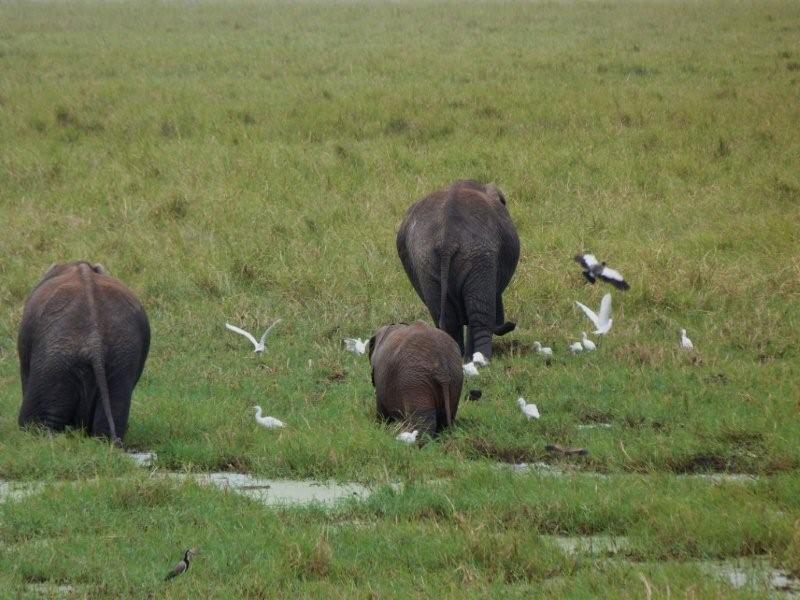 |
| Tarangire Elephants deep in the swamp keep the water open. Aug 2011 |
 |
| Open water created ideal habitat for water birds: Silale Swamp, Tarangire |
 |
| When you're tired of elephants you'd better stop guiding... Tarangire May 2011 |
Sunday, 3 July 2011
Global patterns in forest and savannah species
So I memtioned in my last post how I'd enjoyed taking some of the conference attendees on a little safari on the weekend following the conference. We had a night in Tarangire and then a day in Arusha National Park. Now I'm really an ornithologist, who plays at being a savannah ecologist. I'm not a botanist at all. So driving around with people who really are is always educational, and the number one insight that I got from the weekend was the extraordinary degree to which Bill (who works in Brazillian savannahs) and William (working in African savannahs) could identify a plant - say a Xanthoxylem and William would turn to Bill and ask if they had the same genus in Brazil. To which, almost always, the answer was yes. Even more remarkable (to me) was the fact that on occassions they even had the very same species.
Interestingly, whenever there was a genus match between continents, if we were in a savannah, the same genus was always a savannah plant in Brazil, whilst if we were in the forest on Meru, the South American members of that genera are also forest plants. To me as an ornithologist thinking quickly, I can come up with no more than two or three bird genera that are shared between the continents (there are a few Turdus thrushes in both places, Tyto barn owls, etc.), and that's it.
I was brought up as an ecologist understanding that biogeographical (bio - from biology, geographic, from geography of course - biogeography being the study of distributions of species) similarities between continents could usually be explained by a process known as vicariance. This idea essentially explains the distribution of related species by assuming that a common ancestor of the current species lived on a continent that then moved around through the process of continental drift. A typical example might be the distribution of Ratites - the group of large flightless birds that includes the ostrich. The closest relatives to the ostrich include the emu in Australia, the rhea of South America and the kiwis of New Zealand. Their distribution in these southern continents is explained by their shared ancestor living on the ancient continent of Gondwana, a single continent that eventually broke up (around 200 million years ago) to form the southern continents (plus India and the Arabian peninsular). Each fragment carried a population of this ancient ratites and today we see a distribution of birds across the southern hemisphere.
This explanation of shared ancestry, each population of which floated off on it's own continent it the one that immediately springs to the minds of ecologists of my generation where confronted with similar species across southern continents. But the break-up of Gondwana took place around 200 million years ago - and that's a very long time for evolution to have been acting. Although most ratites are fairly similar and the shared ancestry immediately obvious (though check the kiwis!), they're actually very different and certainly not in the same genus. Now, it's important to remember that, unlike species, genera are not very well defined groups - rather they are a taxonomists attempt to identify common ancestors and group similar species - but whether we group 50 similar species into five genera in one family, or one large and diverse genus within a family is rather more arbitrary than the similar decisions about species (though even there it's actually surprisingly tricky!). So I already knew that the best predictor of how long ago the common ancestor of any particular genus lived is nothing to do with the variety within the species, but everything to do with the number of taxonomists that work on the group - the more taxonomists, the more genera, the more recent the common ancestor. So my first question was whether the common ancestor of these plant species really lived more than 200 million years ago and are just kept in the same genus because there's such a shortage of taxonomists. And I learnt that whilst my head has been full of other things, I've missed one of the biggest revolutions in biogeography of the last decade.
Now we can use DNA to provide fairly accurate dates on when individual species shared common ancestors, we've been able to see that, contrary to the vicariance ideas I've been brought up with, that imply aces over 200 million years, most of the shared genera across the southern continents seem to be far more recent that Gondwanan in origin, which implies that they must, time and time again, have managed to disperse from continent to continent. Wow! What's more, it seems that more often than not, Africa has been the source of the movement, rather than the recipient. Amazingly (to me at least) even some plant species that are dioecous - i.e. have male and female plants - have amnaged to generate almost global distributions through regular long-distance colonisation events. (Unfortunately plant names have a habit of slipping my mind and I can't remember the one that impressed me most - and my pencil was broken so I couldn't take notes. Rubish, huh?!) That is pretty extraordinary I think! So next time you wonder how a seed disperses from a tree, and how it could ever move more than a few metres, remember that most of these genera have managed to get from one continent to another, probably several times! Surprisingly, though, despite these multiple movements across continents, whenever a plant does make the jump it has never (or nearly never) colonised a different biome - savannah plants have to find themselves a slot in a savannah, forest plants in a forest. Which probably tells us all sorts of interesting things about how plant communities are put together, but that will have to wait for another post...
 |
| Botanists getting serious, Tarangire June 2011. I think it's a grass. |
I was brought up as an ecologist understanding that biogeographical (bio - from biology, geographic, from geography of course - biogeography being the study of distributions of species) similarities between continents could usually be explained by a process known as vicariance. This idea essentially explains the distribution of related species by assuming that a common ancestor of the current species lived on a continent that then moved around through the process of continental drift. A typical example might be the distribution of Ratites - the group of large flightless birds that includes the ostrich. The closest relatives to the ostrich include the emu in Australia, the rhea of South America and the kiwis of New Zealand. Their distribution in these southern continents is explained by their shared ancestor living on the ancient continent of Gondwana, a single continent that eventually broke up (around 200 million years ago) to form the southern continents (plus India and the Arabian peninsular). Each fragment carried a population of this ancient ratites and today we see a distribution of birds across the southern hemisphere.
 |
| Ostrich are ratites, a typical Gondwanan group with a distribution explained by vicariance |
This explanation of shared ancestry, each population of which floated off on it's own continent it the one that immediately springs to the minds of ecologists of my generation where confronted with similar species across southern continents. But the break-up of Gondwana took place around 200 million years ago - and that's a very long time for evolution to have been acting. Although most ratites are fairly similar and the shared ancestry immediately obvious (though check the kiwis!), they're actually very different and certainly not in the same genus. Now, it's important to remember that, unlike species, genera are not very well defined groups - rather they are a taxonomists attempt to identify common ancestors and group similar species - but whether we group 50 similar species into five genera in one family, or one large and diverse genus within a family is rather more arbitrary than the similar decisions about species (though even there it's actually surprisingly tricky!). So I already knew that the best predictor of how long ago the common ancestor of any particular genus lived is nothing to do with the variety within the species, but everything to do with the number of taxonomists that work on the group - the more taxonomists, the more genera, the more recent the common ancestor. So my first question was whether the common ancestor of these plant species really lived more than 200 million years ago and are just kept in the same genus because there's such a shortage of taxonomists. And I learnt that whilst my head has been full of other things, I've missed one of the biggest revolutions in biogeography of the last decade.
 |
| Meru's forests were full of genera also found in South America (and Australia!) Erica have interesting distributions, but not in the New World. |
Tuesday, 28 June 2011
Conference insights
A couple of weeks ago I enjoyed spending the week at a combined meeting of the Association for Tropical Biology and Conservation and the Society for Conservation Biology's African chapter, here in Arusha. Now Arusha is not particularly a hub of scientific activity, so if you're an academic, far from colleagues any conference is going to be worth attending, and an international meeting of these two groups is probably a one-off opportunity (in fact, it's the first time ever the ATBC has met in Africa, let along Tanzania. One could wonder where the tropics really are...). So, for four days I was eyeball deep in science once more. Along side the talks, I was organising a workshop on fire and burning Serengeti, then last week I was teaching a course associated with the conference, so I decided to give talking at the meeting a miss this time (not to mention the fact that the abstract deadline once again caught me unawares...), and was able to sit and enjoy lots of interesting things. I'd have blogged about the highlights whilst they were happening, had I not been too busy with other things in the evenings. But now I've got time and am looking back over the notes, thinking I might summarise a couple of interesting facts I learnt today, and maybe some more tomorrow.
So. A talk by Damian Bell from the Honeyguide Foundation (about which all Asilia guides should already know, of course), was the first that had me reaching for my notebook. He had to hand some useful facts directly relevant to conservation, one of the 10 things I think worth talking about when there aren't any lions. Most striking to me were some figures from TANAPA's annual report (from 2007, as it happens, but I doubt they've changed much since then). TANAPA - the Tanzania National Park authority that manages all of the National Parks in Tanzania - had revenue of 69billion TSh (that was about $42,000,000 US) in 2007. This will almost all come from gate fees and bed fees - not a bad income. Of that, of course, TANAPA pay 50% in tax back to the government, but the bit that struck me was the fact that only 1.8% of the income in spent in local community related projects around the protected areas. It seems self-evident that if local populations don't see some benefit from conservation - and financial benefits are surely the most direct - then they're no going to be particularly supporting of the National Park when things are under pressure. So to see just 1.8% heading back to the communities seems extraordinarily short-sighted.
It's not good on village land either - 60% of revenues generated by villages for wildlife related things goes straight to Wildlife Division, leaving only 40% for the villagers. And things are only a little better for Wildlife Management Areas - 60% of the revenue generated by a WMA stays local (40% goes to Wildlife Division), but from this the WMA has to fund all the protection and visitor access things, so it's still not clear how much will actually be felt by local villagers.
Damian also had some interesting figures on quite how much benfit the tourism industry can generate aside from conservation fees - Grumeti Reserves are currently spending $30,000 on fruit and vegetables to local farmers each month. This sort of tourism-related revenue clearly offers massive benefits, well over and above what could come from TANAPAs 1.8% investment. So it's clear that tourism can play a vital role in financing conservation - without it, there's no way we'd have the parks we do today. But, of course, tourism also needs to be controlled if its not to cause more problems than it solves. Though that's a story for another day...
The next talk that had me scribbing was the final answers to his PhD research into the Wildebeest migration into and out of Tarangire National park, by Dr Tom Morrison. Tom started by reporting the staggering decline in Wildebeest numbers from this ecosystem - between 1990 and 2000 the numbers dropped from 43,000 to only just over 5,000. Today Tom tells me there are between 2500 and 5000 remaining. Of course this is nothing to the numbers of wildebeest back in the 1960 when we know the decline began. Tom's focus has been trying to determine where, exactly, the migrant wildlbeest go and how much movement between calving areas there are. We knew that animals from Tarangire go to two main areas - via Manyara Ranch up to the nutrient rich grasslands on the way to Lake Natron, and out east of the park to the Simanjiro Plains. It has also been suggested that animals might move to Lake Manyara National Park too, so he went there for good measure. Tom didn't want to just know where one or two animals went, he wanted to know them all. And he wanted to know if the same animal might switch from place to place each year, or if they always went to the same area. So he couldn't got for the most expensive option of satellite tracking all the animals - instead he decided to take photos.
Just like zebra stripes, wildebeest stripes on their flanks are individually recognisable. So Tom and his colleagues made a clever computer program that will search through thousands of photos and match pictures of animals with the same stripes. All he then needed to do was take lots of pictures in Tarangire and all the breeding areas over several years and join the dots. Five years and 9000 photos later, he's managed to trace movements of 900 animals - that's a significant proportion of all the animals out there - and he discovered some interesting things. Firstly (and probably most importantly) the Tarangire population is a single population - about 18% of animals did switch calving grounds between years. Animals calving in Simanjiro one year may well calve up at Natron next year. Next he confirmed that the animals in Manyara National Park are more or less resident, living there all year around, with very little interchange with the animals calving near Natron. But the result that seems most surprising to me is that the only thing that really determined whether or not an animal would switch calving grounds one year to another, was if it calved successfully. If I'd been asked to guess before hand, I'd suggest that an animal that calved successfully one year would want to return to the same place to calve again the next year, whereas an animal that failed might decide to try somewhere else next year - but Tom showed that the opposite occurred and more switches happen after successful calving than after unsuccessful calving. Very strange - any ideas anyone? Disease? Who knows... He also showed that successful calving has a cost to females, with them having a lower survival in years when they calve - that wouldn't be any surprise to anyone who brings up small children if they had to live in an area with lots of lions and constant distractions too!
Anyway, very interesting things, I'm sure you'll agree! Hopefully something to pass on to visitors too.
So. A talk by Damian Bell from the Honeyguide Foundation (about which all Asilia guides should already know, of course), was the first that had me reaching for my notebook. He had to hand some useful facts directly relevant to conservation, one of the 10 things I think worth talking about when there aren't any lions. Most striking to me were some figures from TANAPA's annual report (from 2007, as it happens, but I doubt they've changed much since then). TANAPA - the Tanzania National Park authority that manages all of the National Parks in Tanzania - had revenue of 69billion TSh (that was about $42,000,000 US) in 2007. This will almost all come from gate fees and bed fees - not a bad income. Of that, of course, TANAPA pay 50% in tax back to the government, but the bit that struck me was the fact that only 1.8% of the income in spent in local community related projects around the protected areas. It seems self-evident that if local populations don't see some benefit from conservation - and financial benefits are surely the most direct - then they're no going to be particularly supporting of the National Park when things are under pressure. So to see just 1.8% heading back to the communities seems extraordinarily short-sighted.
It's not good on village land either - 60% of revenues generated by villages for wildlife related things goes straight to Wildlife Division, leaving only 40% for the villagers. And things are only a little better for Wildlife Management Areas - 60% of the revenue generated by a WMA stays local (40% goes to Wildlife Division), but from this the WMA has to fund all the protection and visitor access things, so it's still not clear how much will actually be felt by local villagers.
Damian also had some interesting figures on quite how much benfit the tourism industry can generate aside from conservation fees - Grumeti Reserves are currently spending $30,000 on fruit and vegetables to local farmers each month. This sort of tourism-related revenue clearly offers massive benefits, well over and above what could come from TANAPAs 1.8% investment. So it's clear that tourism can play a vital role in financing conservation - without it, there's no way we'd have the parks we do today. But, of course, tourism also needs to be controlled if its not to cause more problems than it solves. Though that's a story for another day...
The next talk that had me scribbing was the final answers to his PhD research into the Wildebeest migration into and out of Tarangire National park, by Dr Tom Morrison. Tom started by reporting the staggering decline in Wildebeest numbers from this ecosystem - between 1990 and 2000 the numbers dropped from 43,000 to only just over 5,000. Today Tom tells me there are between 2500 and 5000 remaining. Of course this is nothing to the numbers of wildebeest back in the 1960 when we know the decline began. Tom's focus has been trying to determine where, exactly, the migrant wildlbeest go and how much movement between calving areas there are. We knew that animals from Tarangire go to two main areas - via Manyara Ranch up to the nutrient rich grasslands on the way to Lake Natron, and out east of the park to the Simanjiro Plains. It has also been suggested that animals might move to Lake Manyara National Park too, so he went there for good measure. Tom didn't want to just know where one or two animals went, he wanted to know them all. And he wanted to know if the same animal might switch from place to place each year, or if they always went to the same area. So he couldn't got for the most expensive option of satellite tracking all the animals - instead he decided to take photos.
 |
| Wildebeest showing their stripes whilst on the move at Mwiba Game Rance, Feb 2011. |
Just like zebra stripes, wildebeest stripes on their flanks are individually recognisable. So Tom and his colleagues made a clever computer program that will search through thousands of photos and match pictures of animals with the same stripes. All he then needed to do was take lots of pictures in Tarangire and all the breeding areas over several years and join the dots. Five years and 9000 photos later, he's managed to trace movements of 900 animals - that's a significant proportion of all the animals out there - and he discovered some interesting things. Firstly (and probably most importantly) the Tarangire population is a single population - about 18% of animals did switch calving grounds between years. Animals calving in Simanjiro one year may well calve up at Natron next year. Next he confirmed that the animals in Manyara National Park are more or less resident, living there all year around, with very little interchange with the animals calving near Natron. But the result that seems most surprising to me is that the only thing that really determined whether or not an animal would switch calving grounds one year to another, was if it calved successfully. If I'd been asked to guess before hand, I'd suggest that an animal that calved successfully one year would want to return to the same place to calve again the next year, whereas an animal that failed might decide to try somewhere else next year - but Tom showed that the opposite occurred and more switches happen after successful calving than after unsuccessful calving. Very strange - any ideas anyone? Disease? Who knows... He also showed that successful calving has a cost to females, with them having a lower survival in years when they calve - that wouldn't be any surprise to anyone who brings up small children if they had to live in an area with lots of lions and constant distractions too!
Anyway, very interesting things, I'm sure you'll agree! Hopefully something to pass on to visitors too.
Subscribe to:
Posts (Atom)