Thursday, 14 March 2013

Common birds: Red-billed Quelea, commonest bird in the world?

1000s of quelea at a dam on Manyara Ranch
I've been struggling to think of the next common bird to do something interesting with, until the obvious solution came to me, possibly the world's most abundant bird, the red-billed quelea.

So, first the identification. The most obvious thing about red-billed queleas are, as the name suggests, a large red beak! Apart from that feature, females and non-breeding males are rather nondescript, small sparrow-like birds. Breeding males are rather brighter, with the red bill surrounded by a black face and variable amounts of orange on the top of the head and breast, with otherwise sparrow-like brown streaks on the back and wings. Perhaps the most useful identification feature though is the fact that you almost never see just one, but flocks of tens, hundreds or thousands of busy quelea all searching for grass seeds or drinking at waterholes.

Thursday, 31 January 2013

Common Birds: the case of the Baglafecht Weaver and missing forests

Male Baglafecht Weaver, Mt Kilimanjaro

 If you live on or near an East African mountain, you're very likely to have Baglafecht Weavers in your garden. Like most of the other true weavers, they're a basic black and yellow colour. The first thing to look at in weavers is usually the colour of the eyes and legs: in Baglafecht weavers you'll always see a yellow eye (easy to see against the surrounding black feathers) and pink legs. Males and females differ slightly: males in the population in northern Tanzania and Kenya have only a black mask on the face, with yellow on the top of the head right down to the (black) beak. Females have an all dark head. In northern Tanzania the back of both sexes is essentially black, with some yellow wing edges, in other areas of Tanzania the back is greenish/grey and not as strongly contrasting. Juveniles of all forms are rather greener and lacking in black, but still have the yellow eye. Like other weavers, they weave their nests from grasses in colonies of 5-15 pairs (not usually in very large groups) and males in the breeding season are pretty noisy with their rather scratchy and squeeky song!
Baglafecht weaver nests aren't the neatest of affairs...

Wednesday, 23 January 2013

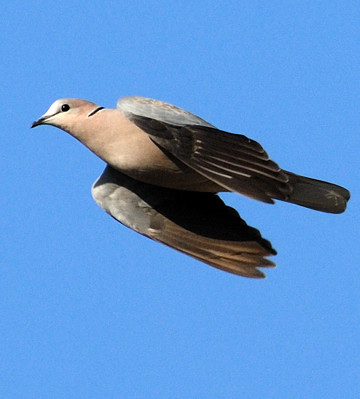
Common birds: Ring-necked Dove

Ring-necked Dove (Cape Turtle Dove) in Tarangire, photo from here
Two more challenges have been set since the last one, and I'm hoping to rise to each! The first was for the African Collared Dove, however that species (Streptopelia roseogrisea) from the drier north of Africa in the Sahel and in the Middle East is not found in Eastern or Southern Africa and I suspect request was for a Ring-necked Dove Streptopelia capicola which is indeed one of the commonest birds to be seen in the bush across much of Africa.

The sound of the Ring-necked Dove  is one of the constant backgrounds to a safari in the bush (if you don't know it, the "work harder, drink lager" refrain is available here) and it's actually this distinctive song that is the easiest way to identify the species from among a number of confusingly similar species. The ring-necked dove is a medium sized, grey dove. It has a black collar around the back of its neck and is a paler grey white below, with pale edges to its tail. Unfortunately, that description is would cover just about any of the close relatives of this species, and (as well as listening to the calls) you need to look rather closer to identify the species correctly. Firstly, look at the eye: if it is dark and not obviously surrounded by bare skin, you're probably looking at a Ring-necked Dove. White (not grey) edges to the tail and a generally pale grey would confirm the identity in eastern and southern Africa. If the eye is pale yellowish, with a red ring around it and there's a warmer brownish wash to the back and neck that contrasts with a grey head, you're probably looking at an African Mourning Dove (call) and if its got a dark eye in a bare purple/red patch of skin, and is overall darker looking, with grey tail edges, you're looking at a Red-eyed Dove (call: "I am a Red-eyed Dove").

Sunday, 6 January 2013

Common Bulbul and frugivorous birds

Common Bulbul nesting in Arusha
Thanks to doubtful comments from a colleague, next up in the common bird series is going to be the Common Bulbul. These birds are probably the most widespread birds in Tanzania and should be a familiar sight to everyone, with their dark blackish heads, brown back and tail, and dirty white underparts with yellow under the tail. They're typical garden birds, and often ignored. However, it is often the common birds that we know most about, because they are so easy to study. And common species, simply because there are so many individuals, often have a very irritant role to play in ecosystems - the common bulbul is no exception!

Friday, 7 December 2012

Common birds (1)

Speckled Mousebird, Arusha. Cute, and really quite interesting...
OK, I've been away from here for too long (sorry!), but to encourage me to actually get down and do something, I've decided to start a new little mini-series here on common birds. As any of you who knows me is aware, I happen to rather like birds and will happy spend hours sitting wathing birds at a pond, or even trudging through kilometers of rift valley lakes to count waders. And I have a secret theory that actually, everyone loves birds, they just down all know it. The problem is that there are a lot of different birds out there (do watch Ethan as he tries to see as many as possible this year and records his exploits over here!), they often move rather fast, and people can be easily confused at first. So I thought we'd break it down into some very simple stages and try and start with 50 of the most common / obvious birds on safari or about towns in Tanzania. For each one my challenge is to briefly describe the key features to help you identify it, and then to say something interesting about it. If all goes well, I might even expand my remit to include non-birds, but we'll start with 50 common birds and see how that goes. Rather than throw it all at you in one go (and because there's no way I could write that much in one sitting!), I think I might try three species a post. It might also get a little interactive this way, if anyone wants to help me identify the top 50 species, that would be great,a nd if you've got your own preferred 'factoids' about any of the species, please do chip in!

So, let's start today, in no particular order, with the Speckled Mousebird.

Thursday, 1 November 2012

Ground Pangolins and Convergent Evolution

-->
On a recent safari I was fortunate to get my first ever sighting of a Ground Pangolin. This animal is quite fascinating.
1.     What is it?

Kakakuona (Swahili) is a mammal that belongs to its own Order called Pholidota. It is a monophyletic order which means there is only one family Manidae.


2.     What is it doing?

Sunday, 2 September 2012

Cycads and more botanical revolutions I've missed...

Lake Natron Cycad, near Loliondo. Cycads look rather
palm-like, but are not true flowing plants at all.
Back in April I headed to Loliondo for a few days with a bunch of guides from Thompson Safaris. Along the long and bumpy route I was really pleased to spot some Cycads and jumped out to take a few photos. Spotted in action, I was forced to explain why I was taking pictures of some random tree. My answer at the time was based mainly on the evolutionary history of plants that I'd been taught at school and then probably on into university: Cycads form a remarkably early split from the branching evolutionary tree of seed-bearing plants, their ancestors somehow linking ferns to the much more modern flowering plants.  I was also keen to see this particular species (according to the IUCN commonly known as the Lake Natron Cycad) because it's one more of those remarkably restricted range species that fascinate me.

Now I have a confession to make - once again I was completely wrong!