 |
| Lions: just big kitties really! |
Wednesday, 3 April 2013
How to protect lions?

Thursday, 14 March 2013
Common birds: Red-billed Quelea, commonest bird in the world?
 |
| 1000s of quelea at a dam on Manyara Ranch |
So, first the identification. The most obvious thing about red-billed queleas are, as the name suggests, a large red beak! Apart from that feature, females and non-breeding males are rather nondescript, small sparrow-like birds. Breeding males are rather brighter, with the red bill surrounded by a black face and variable amounts of orange on the top of the head and breast, with otherwise sparrow-like brown streaks on the back and wings. Perhaps the most useful identification feature though is the fact that you almost never see just one, but flocks of tens, hundreds or thousands of busy quelea all searching for grass seeds or drinking at waterholes.
Thursday, 31 January 2013
Common Birds: the case of the Baglafecht Weaver and missing forests
 |
| Male Baglafecht Weaver, Mt Kilimanjaro |
If you live on or near an East African mountain, you're very likely to have Baglafecht Weavers in your garden. Like most of the other true weavers, they're a basic black and yellow colour. The first thing to look at in weavers is usually the colour of the eyes and legs: in Baglafecht weavers you'll always see a yellow eye (easy to see against the surrounding black feathers) and pink legs. Males and females differ slightly: males in the population in northern Tanzania and Kenya have only a black mask on the face, with yellow on the top of the head right down to the (black) beak. Females have an all dark head. In northern Tanzania the back of both sexes is essentially black, with some yellow wing edges, in other areas of Tanzania the back is greenish/grey and not as strongly contrasting. Juveniles of all forms are rather greener and lacking in black, but still have the yellow eye. Like other weavers, they weave their nests from grasses in colonies of 5-15 pairs (not usually in very large groups) and males in the breeding season are pretty noisy with their rather scratchy and squeeky song!
 |
| Baglafecht weaver nests aren't the neatest of affairs... |
Wednesday, 23 January 2013
Common birds: Ring-necked Dove
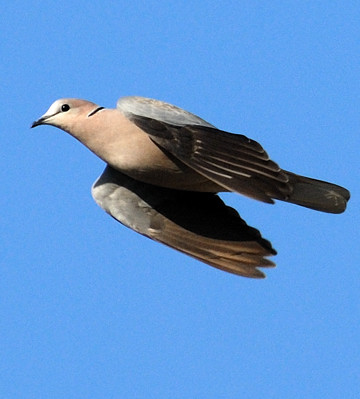 |
| Ring-necked Dove (Cape Turtle Dove) in Tarangire, photo from here |
The sound of the Ring-necked Dove is one of the constant backgrounds to a safari in the bush (if you don't know it, the "work harder, drink lager" refrain is available here) and it's actually this distinctive song that is the easiest way to identify the species from among a number of confusingly similar species. The ring-necked dove is a medium sized, grey dove. It has a black collar around the back of its neck and is a paler grey white below, with pale edges to its tail. Unfortunately, that description is would cover just about any of the close relatives of this species, and (as well as listening to the calls) you need to look rather closer to identify the species correctly. Firstly, look at the eye: if it is dark and not obviously surrounded by bare skin, you're probably looking at a Ring-necked Dove. White (not grey) edges to the tail and a generally pale grey would confirm the identity in eastern and southern Africa. If the eye is pale yellowish, with a red ring around it and there's a warmer brownish wash to the back and neck that contrasts with a grey head, you're probably looking at an African Mourning Dove (call) and if its got a dark eye in a bare purple/red patch of skin, and is overall darker looking, with grey tail edges, you're looking at a Red-eyed Dove (call: "I am a Red-eyed Dove").
Sunday, 6 January 2013
Common Bulbul and frugivorous birds
 |
| Common Bulbul nesting in Arusha |
Friday, 7 December 2012
Common birds (1)
 |
| Speckled Mousebird, Arusha. Cute, and really quite interesting... |
So, let's start today, in no particular order, with the Speckled Mousebird.
Thursday, 1 November 2012
Ground Pangolins and Convergent Evolution
-->

On a recent safari I was fortunate to get my first ever
sighting of a Ground Pangolin. This animal is quite fascinating.
1.
What is it?
Kakakuona
(Swahili) is a mammal that belongs to its own Order called Pholidota. It is a monophyletic order which means there is only one
family Manidae.


2.
What is it doing?
Subscribe to:
Posts (Atom)